EN
EN
PC Sheets vs Acrylic Sheets: A Real Comparison of Safety and Durability
Introduction
In areas such as building daylighting, carports, industrial protection, and home decoration, transparent plastic sheets have long been a mainstream market choice. However, when faced with both Polycarbonate (PC) sheets and Acrylic (PMMA) sheets — both marketed as “highly transparent and impact-resistant” — how should buyers and project contractors make the right decision?
This article provides a systematic comparison of the two materials across core product parameters and real-world service life, revealing the truth through professional data.
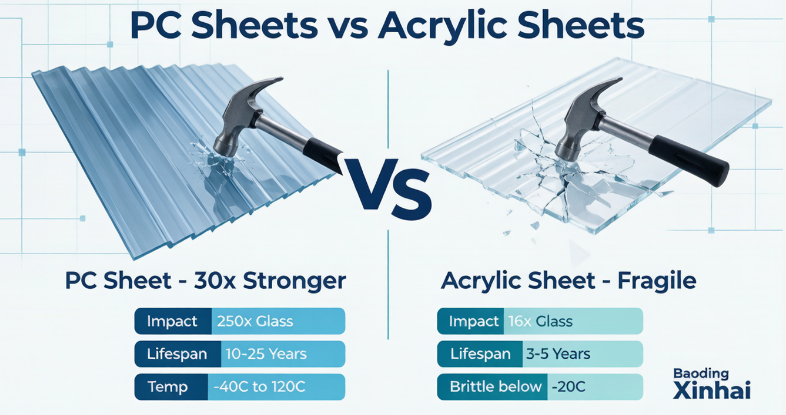
1. Impact Resistance: A 30-Fold Gap — And It’s Not Just a Number
Impact resistance is the gold standard for evaluating safe building sheets, and it is also the parameter where the two materials differ most dramatically.
| Test Item | Polycarbonate (PC) Sheets | Acrylic (PMMA) Sheets |
|---|---|---|
| IZOD Impact Strength | 60–80 kJ/m² | 10–15 kJ/m² |
| vs. Ordinary Glass | 250–300× | 16× |
| vs. Acrylic | 30× stronger | Baseline |
| 3kg Weight Drop Test (2m) | No cracks | Shattered |
Lab Verification: A 3kg weight dropped from 2 meters — the PC sheet remained intact while the acrylic sheet shattered.
Core Conclusion: Polycarbonate sheets deliver 6–10× the IZOD impact strength of acrylic sheets. In typhoon-prone regions or scenarios with risk of falling objects, PC sheets are the only reliable choice. Acrylic is brittle and prone to cracking or shattering upon impact, posing significant safety hazards.
2. Service Life: 5 Years vs. 25 Years — Time Is the Biggest Cost
A material’s service life directly determines the total lifecycle cost of a project. This is the most overlooked yet critical factor in procurement decisions.
| Performance Dimension | Polycarbonate (PC) Sheets | Acrylic (PMMA) Sheets |
|---|---|---|
| Outdoor Rated Lifespan | 10–25 years | 3–5 years |
| 3-Year Yellowing Index | ≤5% | Rapid yellowing |
| 10-Year Light Transmittance Loss | Only 6%–10% | Significant decline |
| UV Protection | Dual UV coating, blocks 99% UV | No natural UV protection |
| Brittleness Temperature | -40°C | -20°C |
Key Insight: After 3–5 years of outdoor use, acrylic sheets develop noticeable yellowing and embrittlement with a sharp drop in light transmittance. Premium PC sheets with UV coating maintain a yellowing index within 3% even after 10 years in high-altitude, high-UV environments, retaining over 85% of their original impact strength after 20 years.
Core Conclusion: Acrylic’s “3–5 year lifespan” means it needs to be replaced 2–4 times over the lifecycle of a single PC sheet. The total lifecycle cost gap far exceeds the unit price difference.
3. Temperature Tolerance: Real Differences Under Extreme Climates
China spans vast climate zones, from -40°C in the north to 40°C in the south. Material stability under extreme conditions is critical.
| Temperature Parameter | Polycarbonate (PC) Sheets | Acrylic (PMMA) Sheets |
|---|---|---|
| Temperature Range | -40°C to 120°C | -20°C to 70°C |
| High-Temp Softening Point | Stable at 120°C | Begins softening at ~70°C |
| Low-Temp Embrittlement | Retains flexibility at -40°C | Cracking below -20°C |
| Heat Deflection Temp | ≥137.4°C | ≥98°C |
Field Cases: In Heilongjiang winter testing, PC sheets retained excellent toughness at -40°C while acrylic sheets showed embrittlement and cracking. In Xinjiang Turpan high-temperature testing, acrylic sheets softened and deformed above 70°C, while PC sheets performed stably throughout.
Core Conclusion: PC sheets offer a temperature range more than twice as wide as acrylic. PC sheets handle extreme climates across China’s frigid north and scorching northwest; acrylic faces significant regional limitations.
4. Safety and Fire Resistance: A Life-Safety Metric
| Safety Indicator | Polycarbonate (PC) Sheets | Acrylic (PMMA) Sheets |
|---|---|---|
| Fire Resistance Rating | Class B1 (self-extinguishing) | Flammable |
| Burning Behavior | Difficult to ignite, no dripping | Spreads fire, drips molten material |
| Fragment Hazard | “Bends rather than breaks” — no sharp shards | Shatters into sharp, dangerous fragments |
| Sound Insulation | 3–4 dB better than glass | No special advantage |
Safety Warning: In public spaces, schools, and factories, if a fire occurs, acrylic sheets — being flammable and producing molten drips — will accelerate flame spread and cause secondary damage. PC sheets’ self-extinguishing properties buy precious time for evacuation and asset protection.
Core Conclusion: In safety-critical applications (school partitions, factory shields, carports, canopies), PC sheets’ “bends rather than breaks” characteristic eliminates dangerous shard hazards — making PC a genuinely safe material.
5. Weight and Fabrication: Structural Differences in Installation Cost
| Fabrication Indicator | Polycarbonate (PC) Sheets | Acrylic (PMMA) Sheets |
|---|---|---|
| Weight vs. Glass | 1/2 of glass | Heavier |
| Cold Bending | Cold-bendable (radius = 175× sheet thickness) | Requires heat forming, prone to deformation |
| Thermal Forming | Flexible cold/hot bending | Requires heat forming, complex process |
| Surface Hardness (Mohs) | HB–1H (hard-coat available) | 3–4 (better scratch resistance) |
Project Note: PC sheets can be cold-bent into curved shapes to meet complex design requirements, significantly reducing construction difficulty and timeline. Acrylic requires heat forming with a complex process and is prone to deformation. Additionally, PC’s lighter weight makes high-altitude work safer and reduces support structure costs.
Core Conclusion: PC sheets hold a comprehensive advantage in fabrication convenience and installation cost. Acrylic has slightly higher surface hardness, but in real-world applications, this difference is negligible in engineering decision-making.
6. Parameter Comparison at a Glance
| Comparison Item | Polycarbonate (PC) | Acrylic (PMMA) | PC Advantage |
|---|---|---|---|
| Impact Strength | 60–80 kJ/m² | 10–15 kJ/m² | 6–10× |
| Light Transmittance | 85%–90% | 92% | Slightly lower (marginal gap) |
| Outdoor Lifespan | 10–25 years | 3–5 years | 3–5× |
| Temperature Range | -40°C–120°C | -20°C–70°C | 2× wider |
| Fire Resistance | Class B1 | Flammable | Fundamental difference |
| UV Blockage | 99% | None | Fundamental difference |
| 10-Year Transmittance Loss | ≤10% | Significant decline | Clear advantage |
| Sound Insulation | +3–4 dB | No advantage | Effective insulation |
| Weight | Lighter | Heavier | Easier handling |
| Cold Bending | Cold-bendable | Requires heat forming | Easier installation |
Closing: A Smart Choice Is an Investment in the Future
The data clearly demonstrates — polycarbonate sheets comprehensively outperform acrylic sheets across every core dimension: impact resistance, service life, temperature tolerance, and fire safety.
Acrylic’s only “advantage” is slightly higher light transmittance (92% vs. 90%) and marginally better surface hardness. In practice, 90% transmittance fully satisfies the vast majority of daylighting needs, and the minor hardness difference is practically negligible in real construction scenarios.
For buyers and project contractors who prioritize long-term safety and total lifecycle cost optimization, polycarbonate sheets deliver — through a single procurement decision — 3–5× the service life, 6–10× the impact safety, and fundamental fire safety protection — an investment that pays dividends throughout more than a decade of reliable service.