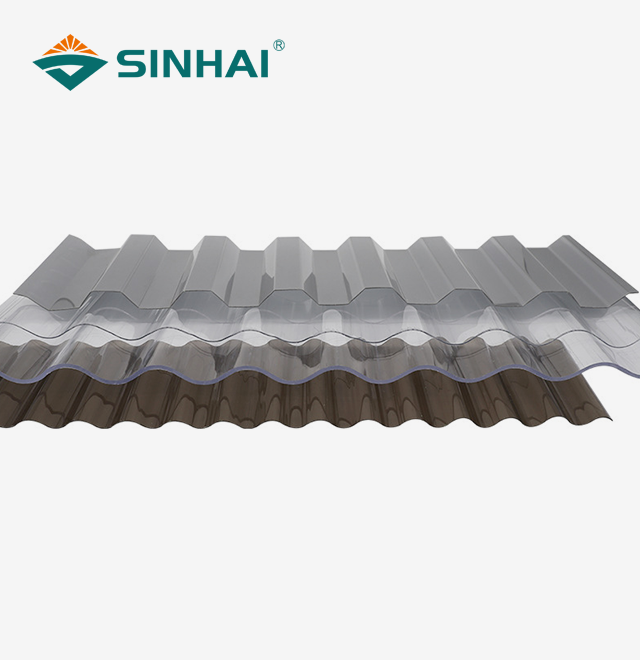
Polycarbonate Wave Sheet for Roofing & Canopy Projects — Strong, Clear, Long-Lasting
Each polycarbonate wave sheet is made from 100% virgin resin and we provide imported SABIC or BAYER material. Baoding Sinhai Sunboard Manufacturing Co., Ltd. Clear sheets provide light transmission of up to 88% and impact resistance 250-300 times that of glass. Service temperature range is -40°C to +120°C. Sinhai is a trustworthy partner for worldwide markets in bulk orders, mixed container purchasing, and OEM/ODM projects, with 3 production bases, 25+ manufacturing lines and yearly output of more than 60,000 tonnes.
What Is a Polycarbonate Wave Sheet?
For light-transmitting roofing and wall applications, a polycarbonate wave sheet is a corrugated thermoplastic cladding material. It’s manufactured from virgin polycarbonate resin, the same basic material used in SABIC’s Lexan and BAYER’s Makrolon product lines.
Unlike glass, it doesn't break when hit by hail or wind. Unlike PVC or fibreglass (FRP) it is resistant to quick yellowing and embrittlement. Its sinusoidal or trapezoidal wave shape delivers structural stiffness and better water-shedding allowing greater purlin spans and cheaper installation costs.
Key Technical Specifications
| Parameter |
Details |
| Thickness |
0.75 – 3.0 mm |
| Wave Type |
Sinusoidal and trapezoidal |
| Available Molds |
70+ free molds |
| Light Transmission |
Up to 88% (clear sheets) |
| Impact Resistance |
250–300× stronger than glass |
| Service Temperature |
-40°C to +120°C |
| Density |
Approx. 1.2 g/cm³ |
| UV Protection Layer |
Co-extruded, 50–100 microns, 1 or 2 faces |
| Colors |
Transparent, bronze, grey, opal, lake blue, amber, dark blue, silver, orange, yellow, or custom |
| Raw Material |
100% virgin PC / SABIC / BAYER / customized |
| Warranty |
10–20 years against yellowing and breakage (subject to application conditions) |
Core Product Advantages
Impact Strength for Real-World Conditions
The sheets are 250-300 times more impact resistant than glass and can sustain large hail and significant wind loads. The falling weight impact test (ISO 6603) simulates hail striking circumstances and is used for quality control to validate impact performance.
Up to 88% Light Transmittance
Clear sheets transmit up to 88% of natural light making them a viable alternative for greenhouses, warehouses and skylights where sunshine saves lighting energy costs without sacrificing structural protection.
Wide Temperature Range:
Service range from -40°C to +120°C maintains sheets stable during frigid winters and high-heat summers. Good airflow is recommended for interior temperature management for enclosed or poor ventilated locations.
UV Protection - Co-Extruded
Each sheet has a 50-100 micron co-extruded UV protection coating on one or both sides. This layer filters damaging UV light, which slows yellowing and surface ageing. Long-term clarity is proven by the yellowing index test (ASTM D1925).
Thickness Options to Suit Project Loads
The range from 0.75 to 3.0 mm includes everything from modest ornamental canopies to heavy-duty industrial roofing. Thinner sheets are utilised for pergolas and awnings, thicker sheets for warehouse skylights and coverings for industrial greenhouses.
Fire Retardants
Sheets satisfy Class B1 flame retardancy criteria (EN 13501). They are also self-extinguishing and do not contribute to flame spread – a key criterion for commercial and industrial building applications.
Where These Sheets Are Used?
Polycarbonate wave sheets are used in a very broad variety of construction and agricultural projects:
- Industrial Skylights Commonly used in large warehouses and industries to bring in natural light while resisting chemical odours and heavy wind loads.
- Commercial Greenhouses - High PAR light transmission encourages plant development, while impact resistance may withstand high snow loads and hail up to 25 mm in diameter.
- Coastal architecture projects — The corrosion resistance makes them excellent for stadium canopies, walkway coverings and patio roofs in salt mist situations where metal roofing deteriorates prematurely.
- Residential applications – The lightweight, sturdy wave profile is perfect for carports, pergolas, awnings, pool covers and corridor roofs.
- Cold-bent curved roofs – Sheets may be longitudinally cold-bent to a minimum radius of approx. 4 m for conventional wave profiles, so that curved roof designs are possible.
Quality Control Process
Sinhai performs quality checks at three levels: incoming raw material, in-process manufacturing and final inspection before shipping.
Five critical parameters are checked on each manufacturing run:
- UV Layer Verification – Micro-spectroscopy shows minimum co-extruded UV layer thickness of 50 microns.
- Yellowing Index (ΔYI) — Tested according to ASTM D1925 to ensure optical clarity for the life of the guarantee.
- Dimensional Accuracy - The heights, pitch and thickness of the wave are checked for uniform overlap and water-tight installation.
- Impact Resistance — Hail-impact behaviour is confirmed using falling dart testing in accordance with ISO 6603.
- Weight per Square Meter – Confirmed with virgin resin standard to determine any recycled material or fillers.
Products are ISO 9001:2015, CE, RoHS and UDEM certified to suit international market entry standards.
Customization & OEM/ODM Services
We at Singhai provide complete OEM and ODM manufacturing. Available choices include:
- CNC cutting with custom sheet dimensions
- Non-standard project criteria for small orders
- Film coating on one or two sides
- Special-shaped cutting, bending, vacuum forming and thermoforming for solid PC versions
- 3D project profile modelling
In most circumstances it may be done without bespoke tooling to fit your current metal roofing system with more than 70 free moulds available for trapezoidal, round wave and other profiles.
Packaging & Logistics
Sheets are covered with UV-side orientation guide printed on PE masking film. Standard packing is suitable for marine, road and air freight.
Regular orders take about 7 days for completion. Delivery to the markets of Central Asia is possible in around 7 days from the Kashgar manufacturing base. We have local warehousing capabilities in Tashkent and Dushanbe for speedier regional fulfilment.
FAQ
Q1: Will it fit my existing metal roof profile?
A: Sinhai stocks 70+ profile molds — including trapezoidal and round wave types — designed to match standard global metal roofing profiles. If your profile is non-standard, custom mold development is available through the OEM service.
Q2: Does the sheet expand and contract in heat?
A: Yes. Polycarbonate has a measurable thermal expansion rate. During installation, pre-drill holes 2–3 mm larger than the screw diameter to allow the sheet to move without cracking at fastener points.
Q3: How many screws do I need per sheet?
A: For a standard 1050 mm width sheet, 5–6 screws per purlin is the recommended fixing pattern. Always fix screws at the crest of the wave — not in the valley — to prevent water ingress.
Q4: Can I walk on the sheets during installation?
A: No. Corrugated sheets are not designed to bear a person's weight directly. Use ladders or roof boards spanning across the support purlins to distribute load safely.
Q5: How do I clean the sheets without causing damage?
A: Use mild soap and a soft cloth with lukewarm water. Avoid ammonia-based cleaners, solvents, or abrasive tools, as these degrade the UV coating and reduce long-term weathering performance.
Q6: Which side should face the sun?
A: The side carrying the co-extruded UV layer must face outward toward the sun. This is marked on the masking film with a printed label or "this side up" indicator.
Contact Us
Do you have more questions about polycarbonate wave sheet? Send your project specs — dimensions, wave profile, quantity, and destination — to [email protected].