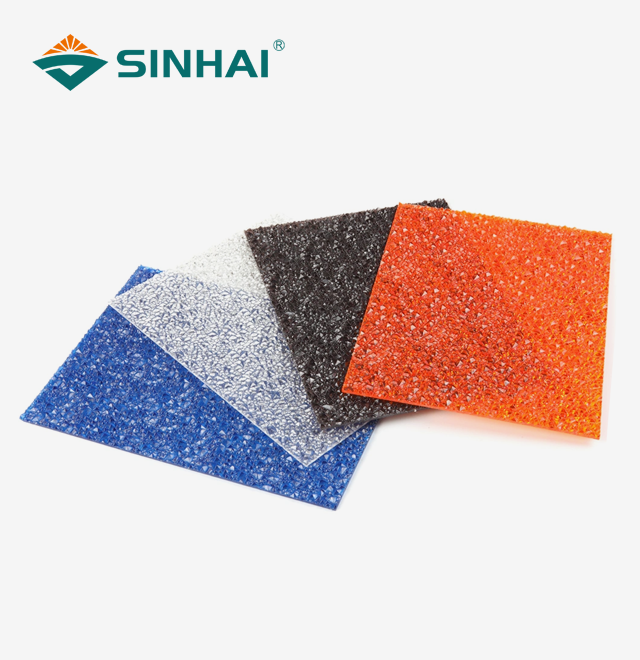
Embossed PC Sheet for Partitions, Roofing & Decorative Panels
Baoding Sinhai Sunboard Manufacturing Co., Ltd. is a polycarbonate sheet producer with more than 30 years of experience, 3 production bases, 25+ manufacturing lines and an annual output of over 60,000 tonnes in a factory size of 50,000+ m2. The embossed PC sheet is available from 1.5 mm to 6.0 mm, manufactured with 100% virgin resin or imported SABIC/BAYER resin and rated for service at -40°C to +120°C. Certifications: ISO 9001:2015, CE, RoHS, UDEM
What Is an Embossed PC Sheet?
Solid polycarbonate embossed PC sheets have a textured surface on one side after extrusion. We mould diamond, water-drop, and lychee grain patterns directly into the surface without chemical etching or additional coating.
The three-dimensional surface design hides tiny scratches and fingerprints on a flat sheet, scatters direct light for softer, more uniform lighting, and twists sightlines for visual privacy.
Key Product Specifications
| Parameter |
Details |
| Thickness |
1.5 mm – 6.0 mm |
| Surface |
One side embossed, one side smooth |
| Light Transmittance |
35%–80% (varies by texture depth) |
| Temperature Tolerance |
-40°C to +120°C |
| Impact Resistance |
250–300× glass; 30× acrylic |
| UV Protection Layer |
50–106 microns, co-extruded (1 or 2 faces) |
| Colors Available |
Transparent, Bronze, Grey, Opal, Lake Blue, Amber, Dark Blue, Silver, Orange, Yellow, or custom |
| Material |
100% virgin resin / SABIC / BAYER / customized |
| Fire Rating |
Self-extinguishing; UL94 V-0 or V-2; B1 (GB8624) |
| MOQ |
500 m² |
| Free Sample |
Available within 3 days |
| Certifications |
ISO 9001:2015, CE, RoHS, UDEM |
Product Performance
Resistance to impact. Embossed PC sheet is a good choice for high-traffic areas, industrial canopies, and safety glazing applications since it has 250–300 times the impact resistance of glass and 30 times that of acrylic.
Diffusion and transmittance of light. Light transmittance varies from 35% to 80% depending on the depth of the roughness. This collection minimises glare while supporting practical natural light in covered pathways, greenhouses, and warehouses.
Constancy of temperature. The service range of -40°C to +120°C enables reliable operation in both sun-exposed roofing settings and cold regions.
Fire safety. The material has a UL94 V-0 or V-2 rating, B1 under GB8624, and is self-extinguishing.
UV defence. The co-extruded UV layer (50–106 microns, available on one or both sides) is designed to withstand surface deterioration and yellowing when exposed to the outdoors. Accelerated QUV weathering techniques are used to assess UV performance.
Typical Applications
Interior design and partitions. The textured surface preserves natural light transmission while offering seclusion in business offices, restroom enclosures and retail locations.
Skylights, canopies, and roofing. Applications ranging from major industrial roofs to garden huts and carports are covered by the 1.5–6.0 mm thickness range. There is no harsh glare as light flows through.
Ornamental panels and fences. Outdoor cladding and fence have a structured look thanks to the embossed texture, which also prevents surface deterioration over time.
Machine guards and industrial walkways. The combination of grip and partial visual privacy that the textured surface offers is often required in production settings.
hallways and ceilings. An embossed ceiling panel's diffused light produces a more consistent visual environment and lessens the need for artificial lighting.
Quality Control
At the time of raw material intake, throughout manufacturing, and before export, each batch undergoes a systematic examination. Important checks consist of:
- UV layer measurement: a thickness gauge or microscope verifies the existence and compliance of the co-extruded UV layer.
- Impact resistance testing: The ASTM D5420 falling dart test confirms resistance to impacts at high speeds.
- Dimensional tolerance: digital callipers verify that the textured surface's thickness is consistent within ±0.05 mm.
- Measuring the haze value verifies that light diffusion is consistent throughout the manufacturing batch.
- Colour stability during accelerated UV exposure is measured by the Yellowing Index (YI) in QUV chamber testing.
One of the primary drafting units for the Chinese National Standard for Plastics—Polycarbonate Sheets, which went into effect on April 1, 2025, was Baoding Sinhai Sunboard.
Customization and OEM/ODM
Project needs are not usually met by standard catalogue sizes. The business facilitates OEM and ODM manufacturing, such as:
- Personalised hues and film coatings
- CNC and specially shaped cutting
- Thermoforming and bending
- Custom thickness between 1.5 and 6.0 mm; more than 70 free moulds are available for profile customisation
Typically, standard orders are finished in seven days. With local warehouse resources in Tashkent and Dushanbe accessible for quicker fulfilment, the Kashgar manufacturing base offers regional delivery for Central Asian markets in around seven days.
A logistics staff with competence in cross-border customs clearance handles shipping choices such as air, road, and sea freight.
FAQ
Q1: What is the real purpose of the embossed texture?
A: It has three purposes: the texture obscures the view through the sheet for visual privacy, it diffuses incoming light for gentle and even lighting and it provides a beautiful finish to the surface that is appropriate to industrial and architectural areas.
Q2: Is an embossed version as sturdy as a flat solid sheet?
A: Yes. The texture is generated during extrusion , not by removing material . This means the sheet has the same impact resistance (250-300 times that of glass).
Q3: Which side should be toward the sun?
A: The smooth side, which has the co-extruded UV-protective layer, should be facing outward. The textured side is inward, which also helps hide dust collection in the surface pattern.
Q4: What is the difference between a product and a frosted sheet?
A: An embossed sheet has a physical, moulded texture (like diamond or water-drop patterns). A frosted sheet has a chemically-etched or sand-blasted matte appearance. They both disperse light, but the embossed one has a tactile three-dimensional surface rather than a flat matte look.
Q5: Is it possible to cold-bend the sheet for curving roofs or canopies?
A: Yes. Minimum cold bending radius 175x sheet thickness. 3 mm sheet minimum cold bending radius is 525 mm.
Q6: What is the minimum order quantity? Can I get a sample?
A: MOQ is 500sqm. Contact us to arrange free samples.
Contact Us
Do you have more questions about embossed pc sheet? To request a free sample or a project quote, email [email protected].