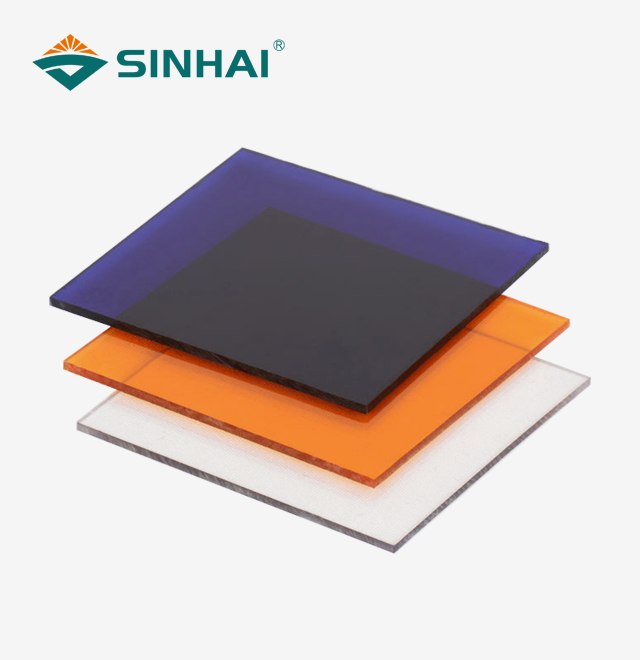
Flat Solid Polycarbonate Sheet for Glazing, Roofing & Security
Flat solid polycarbonate sheet is an engineering thermoplastic manufactured by a continuous coextrusion process using high molecular weight resins. Baoding Sinhai Sunboard Manufacturing Co., Ltd. has 3 production bases, more than 25 manufacturing lines and yearly output of more than 60,000 tonnes. With thicknesses ranging from 0.95mm to 23mm, the material offers 85%–90% light transmission and 98%–100% UV protection, making it suitable for applications ranging from glazing and roofing to machine guarding and acoustic barriers.
What Is a Flat Solid Polycarbonate Sheet?
It offers both optical clarity and structural impact resistance. It has an impact resistance that is 250 times that of glass and 30 times that of acrylic with a typical Charpy notched impact strength of more than 600 J/m.
Much lighter than glass and does not break on contact. Unlike acrylic it doesn’t shatter and stays flexible under duress. Suitable for cold-climate and high-heat situations, the material has a service temperature range of -40°C to +120°C without brittleness or dimensional deformation.
Key Technical Specifications
| Parameter |
Details |
| Thickness |
0.95–23mm |
| Light Transmission |
85%–90% |
| UV Protection Rate |
98%–100% |
| UV Co-extruded Layer |
50–105 microns (1 or 2 faces) |
| Density |
1.2 g/cm³ |
| Service Temperature |
-40°C to +120°C |
| Impact Resistance |
250× glass, 30× acrylic |
| Charpy Notched Impact |
>600 J/m |
| Noise Reduction |
Up to 30–35 dB (10mm sheet) |
| Thermal Expansion |
0.065 mm/m·°C |
| Surface |
Flat, smooth, high gloss |
| Colors Available |
Transparent, bronze, grey, opal, lake blue, amber, dark blue, silver, orange, yellow, or custom |
| Raw Material |
100% virgin resin; SABIC / Bayer available |
| Flame Retardancy |
UL94 V-0 / V-2; Class B1 (GB8624) |
| MOQ |
500 m² |
| Packing |
Rolled or flat sheet on wooden pallet |
Material & Surface Quality
Resin options include 100% new virgin material or imported SABIC / Bayer resin. Both go through the same co-extrusion process, producing a flat, smooth, high-gloss surface. Haze is confirmed below 0.5% per ASTM D1003 testing.
The UV co-extruded layer (50–105 microns, available on one or both faces) is integrated directly into the sheet structure during manufacturing — not applied as a surface coating. This construction keeps the Yellowness Index change (ΔYI) below 3 over 10+ years of outdoor exposure.
Products carry ISO 9001:2015, CE, RoHS, and UL94 certifications.
Application Ranges
The thickness range of this flat solid polycarbonate sheet supports a wide variety of end uses.
Architectural & Roofing
Skylights, canopies, pergolas, awnings, and curtain walls benefit from high light transmission and weather resistance. The sheet withstands wind load and seismic stress conditions that would crack glass.
Industrial Safety & Machine Guarding
In CNC machine enclosures and automated assembly line guards, the material absorbs high-velocity debris impact while maintaining clear, distortion-free operator sightlines.
Security Glazing
Laminated panels are used in bullet-resistant windows for banks and anti-riot shields for law enforcement, where weight reduction and impact performance are both required.
Sound Barriers & Partitions
A 10mm sheet reduces noise by approximately 30–35 dB — suitable for highway sound barriers and office partitions where acoustic performance is a primary requirement.
Other Applications
Greenhouses, swimming pool covers, corridors, advertising light boxes, and industrial daylighting systems all work within the material's full thickness range.
Processing & Customization
Standard processing services available for this flat solid polycarbonate sheet include:
- CNC cutting and special-shaped cutting
- Cold bending (minimum radius = 175× sheet thickness; e.g., 1050mm for a 6mm sheet)
- Drilling using standard power tools
- Printing and film coating
- Thermoforming and vacuum forming
- Bending to custom profiles
OEM and ODM services are supported. 3D design assistance is available prior to production if required.
Quality Control Process
Each production batch goes through five inspections before shipment:
- Dimensional Tolerance — Ultrasonic gauges verify thickness consistency within ±2%–5%.
- Optical Purity — ASTM D1003 testing confirms light transmission at 88%–90% with haze below 0.5%.
- UV Layer Thickness — Microscopic measurement ensures the co-extruded UV layer reaches a minimum of 50 microns.
- Impact Resistance — Falling dart impact tests per ISO 6603 confirm no brittle fracture.
- Accelerated Weathering — QUV chamber testing simulates 10+ years of solar exposure, monitoring ΔYI to keep it below 3.
Installation Notes
Polycarbonate expands more than metal under heat. Allow 3mm per meter of linear expansion during installation to prevent buckling.
For cleaning, use only neutral detergents and soft cloths. The sheet resists many acids and alcohols but is sensitive to aromatic and halogenated hydrocarbons — avoid solvent-based cleaners.
FAQ
Q1: How does its impact resistance compare with glass and acrylic?
A: It offers 250 times the impact resistance of glass and 30 times that of acrylic, with a Charpy notched impact strength exceeding 600 J/m. It will flex and absorb impact rather than fracture.
Q2: Will it yellow or lose clarity over time?
A: Sheets produced with 100% virgin resin and a 50–105 micron UV co-extruded layer maintain a ΔYI below 3 and light transmission above 88% over 10+ years of outdoor exposure, based on QUV accelerated weathering tests.
Q3: Can it be cut or drilled on-site?
A: Yes. Standard circular saws and power drills are compatible. Cold bending to a radius of 175× sheet thickness is also achievable on-site without heating equipment.
Q4: What is the service temperature range?
A: The material remains dimensionally stable from -40°C to +120°C, with no brittleness at low temperatures and no warping at high temperatures within that range.
Q5: Is it suitable for highway sound barriers?
A: A 10mm sheet provides approximately 30–35 dB of noise reduction, which covers typical highway sound barrier and interior partition requirements.
Q6: How should it be cleaned and maintained?
A: Use neutral detergents and soft cloths only. Aromatic solvents and halogenated hydrocarbons can damage the surface and should be avoided.
Contact Us
Do you have more questions about flat solid polycarbonate sheet? Reach us at [email protected] for samples, custom dimensions, or bulk order inquiries.