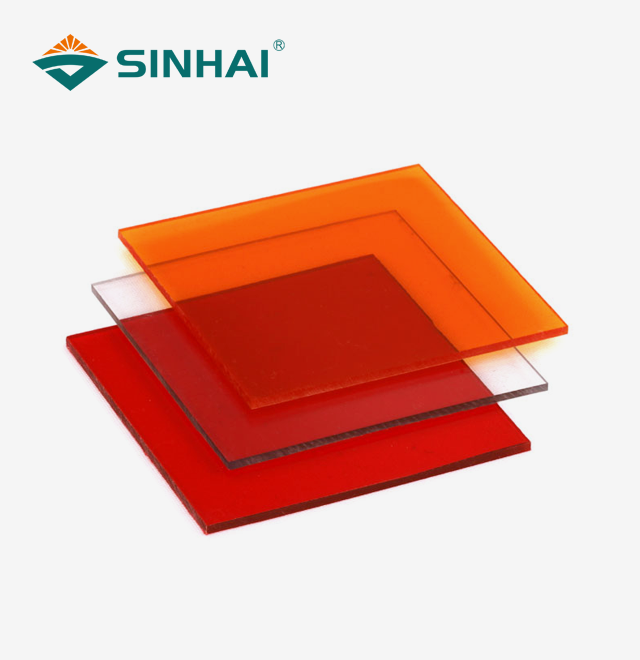
Placas Policarbonato Transparente Lisas — Solid Flat PC Sheets for Structural Glazing and Safety Applications
Placas policarbonato transparente lisas are flat, solid thermoplastic sheets made through a continuous co-extrusion process with polycarbonate resin that has a high viscosity. These sheets are made by Baoding Sinhai Sunboard Manufacturing Co., Ltd., a company with three factories, more than 25 production lines, and an annual output of more than 60,000 tonnes. They let about 90% of light through while being about half the weight of glass and 250–300 times stronger against impact. They come in widths ranging from 0.95 mm to 23 mm and are made for projects that need to be safe and have regular daylighting.
What Sets These Solid Polycarbonate Sheets Apart?
When you hit glass, it breaks. A lot of plastics turn yellow after being outside for a few years. Solid PC sheets solve both problems by choosing the right materials and making them in the right way.
Each sheet is made from 100% brand-new polycarbonate plastic, and you can choose to use foreign SABIC or BAYER material. This makes sure that the chemical structure and optical clarity are the same all the way through. During co-extrusion, a 50–105 micron UV-protective layer is bonded directly onto one or both sides of the sheet during the production process. It is not added as a surface coating afterward.
The UV protection is built into the structure of the sheet, so it doesn't peel or delaminate when it gets wet. It works by blocking ultraviolet light before it can break down the polymer chains. This helps keep light penetration above 88% and keeps the material from turning yellow after being outside for a long time.
Technical Specifications
| Parameter |
Details |
| Thickness Range |
0.95 mm – 23 mm |
| Light Transmission |
88%–92% (varies by thickness) |
| Density |
~1.2 g/cm³ |
| Weight vs. Glass |
~50% lighter |
| Impact Resistance |
250–300× stronger than glass; up to 850 J/m (notched Izod) |
| Operating Temperature |
-40°C to +120°C |
| UV Protection Layer |
50–105 microns, co-extruded (1 or 2 faces) |
| Flammability Rating |
V-2 or V-0 (UL 94); self-extinguishing |
| Cold-Bend Radius |
Min. 175× sheet thickness |
| Colors Available |
Clear, lake blue, bronze, grey, green, opal, amber, dark blue, silver, orange, yellow, or custom |
| Raw Material |
100% virgin resin; SABIC / BAYER options available |
| Certifications |
ISO 9001:2015, CE, RoHS, UDEM |
| Standards Compliance |
ASTM D3763, ASTM D5420 |
Key Performance Characteristics
Resistance to impact for tough conditions. These sheets are 250–300 times stronger than glass and 30 times stronger than acrylic. They can be used for machine guards, security glazing, and high-wind roofing where protecting against fragments is important. Instead of breaking, they take in the collision energy.
Stable at a wide range of temperatures. Sheets' structure stays fixed from -40°C to +120°C, so they don't break down in cold climates or change shape in hot climates. In most construction and industrial settings, this temperature range is ideal for working conditions.
Attenuation of sound. A 10 mm solid PC sheet lowers noise by about 30 to 35 decibels. This is useful for sound barriers on highways, acoustic walls on trains, and office partition systems that need to be both clear and quiet.
Ability to work on-site. When you cut or drill into plastic, it likes to crack, but you can use regular circle saws and drills to work with PC sheets. There is also a way to cold-curve sheets on-site to a radius of at least 175 times their width without using heat.
Application Scenarios
Placas policarbonato transparente lisas are used in architecture and industry projects where glass is too heavy, too fragile, or too likely to break.
Industrial safety glazing includes machine guards, observation windows and high-pressure process areas that need to be able to see and keep fragments in check.
Architectural security: thick-gauge or layered PC is used as an anti-intrusion shield in banks, jewellery shops, prisons, and other high-security areas.
In civil engineering, sound barriers along highways and trains must be able to handle the dynamic wind loads from moving cars while still being clear.
roofs, windows, and canopies: Greenhouse covers, hallway roofs, trellis panels, and swimming pool shelters where letting light through and lowering the structure's weight are both important.
For example, light boxes and outdoor display screens need to be able to keep their visual clarity and UV stability over long periods of time.
Quality Control
Before they are sent out, sheets made at Baoding Sinhai are inspected several times.
With optical purity analysis, black spots, bubbles, and other imperfections are found on every sheet. Using digital callipers to test for thickness tolerance shows that variations stay within ±5% of the standard gauge. To make sure the co-extruded barrier is there and properly bonded, UV layer verification uses microscopic cross-section analysis or fluorescence indicators.
The resistance to impact is checked using the ASTM D5420 falling dart test procedures. Testing the Yellowing Index (YI) under QUV-accelerated weathering checks how well it will work in the long term and makes sure that Delta E stays within the limits set by the industry.
Customization and Supply
You can choose from standard sizes, and OEM/ODM processing can be set up. CNC cutting, bending, special-shaped cutting, film coating, vacuum forming, and thermoforming are some of the processing options.
Orders for small amounts are welcome. Standard orders are usually finished in seven days or less. The Kashgar production base can deliver to Central Asian countries in about seven days, and there are local warehouses in Tashkent and Dushanbe that can help with regional fulfilment.
You can ship by sea freight, truck, or air, and we can help you clear customs for goods going across borders.
Packaging and Shipping
Placas policarbonato transparente lisas are put on wooden boxes to keep them safe during shipping. Depending on the width, a normal 20GP container can hold about 2,000 to 2,500 m² of goods. A PE film is placed on the UV-coated face of each sheet to protect it.
FAQ
Q1: Will it get cloudy or yellow over time?
A: Sheets made from 100% new SABIC or BAYER resin and a co-extruded 50 µm UV layer are made to keep more than 88% of the light passing through without turning yellow when left outside for a long time. The UV protection is built into the sheet, not just added on top.
Q2: Will it not crack if I drill or cut it?
A: Yes. PC material is not stiff; it is bendable. Most circle saws and drills can be used without breaking the material at the cut point. You can also cold-curve sheets on-site to a radius of 175 times their thickness without using any heating tools.
Q3: How does it work in very hot or very cold weather?
A: From -40°C to +120°C, the structure stays stable, so it can be used in both cold northern climates and hot desert climates without breaking or warping.
Q4: Is it good for fences along highways?
A: About 30 to 35 decibels of noise are cut down by a 10 mm sheet. This makes the products a useful standard for soundproofing systems on highways and trains that need to be clear to the eye.
Q5: Can you tell me how polycarbonate is different from acrylic?
A: Polycarbonate is about 250 times stronger than glass when it comes to impact protection, while plastic is only 17 times stronger. Acrylic is a little better at resisting scratches when they are light, but PC is better at handling impact, a wider temperature range, and fabrication on-site for structural and safety uses.
Q6: Do you take orders for small amounts?
A: Yes. Email the team at [email protected] to talk about sizes, amounts, and handling choices.
Contact Us
For samples, custom quotes, or technical data sheets, reach the team at [email protected]. Enquiries about placas policarbonato transparente lisas are typically answered within one business day.