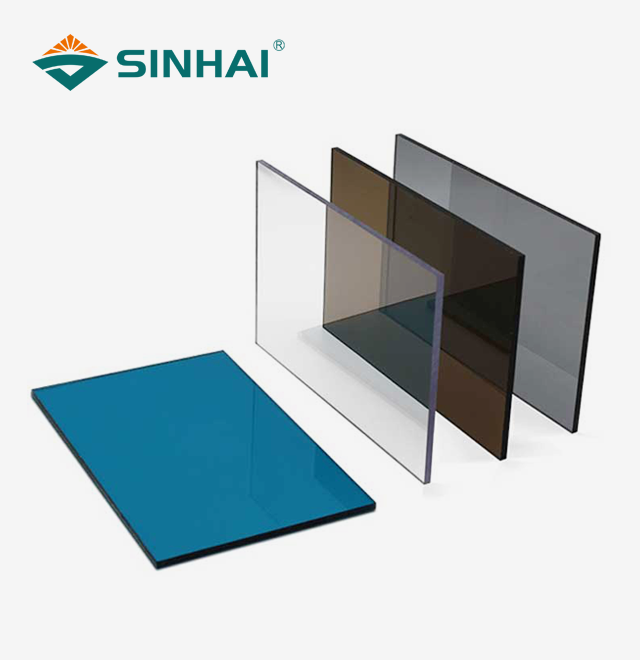
Polycarbonate Solid Roofing Sheets — Impact-Resistant Panels for Roofing & Architectural Applications
Structural load, installation costs and long-term maintenance are affected by choice of glazing material. Polycarbonate solid roofing sheets provide a viable option for roofing, skylights, canopies, and sound barriers when glass fractures under hail or installation stress and acrylic yellows after a few years. These monolithic panels are made from 100% virgin polycarbonate resin by precision co-extrusion and are available in thicknesses from 0.95 mm to 23 mm and widths up to 2100 mm covering a wide variety of construction and industrial applications.
How Solid PC Panels Compare to Glass and Acrylic?
Solid PC panels are about 50% lighter than glass with a density of 1.2 g/cm 3 . This reduction in load reduces the demands on steel substructures and reduces installation labour on large-span roofs. The panels also won’t shatter during transit and handling on site, unlike glass, reducing material waste on bigger projects.
Clear varieties may have light transmission of up to 89 per cent, providing useable natural sunshine without compromising on structural safety. The fire behaviour is also of interest for roofing standards, as polycarbonate is self-extinguishing and the usual fire rating is class B1 or class A, depending on the actual product configuration.
Unlike acrylic, solid PC sheets may be cut and drilled on-site using ordinary circular saws without shattering. They may also be cold-curved to a minimum radius of 175 times the sheet thickness, thereby permitting arched roof designs without the need of thermoforming equipment.
Key Technical Specifications
| Parameter |
Details |
| Thickness |
0.95 – 23 mm |
| Width |
1220 / 1560 / 2100 mm (max) |
| Length |
Customized |
| Impact Strength |
Up to 850 J/m (approx. 250× glass, 30× acrylic) |
| Light Transmission |
Up to 89% (clear variant) |
| Operating Temperature |
-40°C to +120°C |
| Outdoor Service Life |
10 – 20 years |
| UV Protection Layer |
50 – 105 micron, 1 or 2 faces, co-extruded |
| Material |
100% virgin resin; SABIC or Bayer available on request |
| Colors |
Transparent, Bronze, Grey, Opal, Lake Blue, Amber, Dark Blue, Silver, Orange, Yellow, or custom |
| Certifications |
ISO 9001:2015, CE, RoHS, UDEM, KOSHER |
| Fixing Method |
Dry glazing with EPDM gaskets, accommodates thermal movement |
Material Grade and UV Protection
100% pure polycarbonate resin goes into every sheet. Imported grades of resin are available for applications requiring SABIC or Bayer material.
The UV protection layer is co-extruded, not surface coated, at 50 to 105 microns on one or both sides. The layer is manufactured as part of the sheet and so maintains a uniform surface concentration across the life of the product. This is contrasted to UV stabilised products where additives are spread throughout the body of the resin and are not concentrated at the surface where UV exposure is highest.
The co-extruded UV layer provides light transmission over 88% for at least 10 years in outdoor situations, and surface yellowing is kept to a minimum even in high-UV or coastal areas.
Dimensions and Fabrication Options
The thickness range of 0.95 mm to 23 mm enables specifiers to choose the right profile for each application. Thinner sheets are suitable for attractive canopies and light weight coverings. Thicker profiles are employed in industrial roofing, security glazing and load bearing applications.
Widths up to 2100 mm minimise the amount of seams across a roof span, speeding up installation and providing a better visual finish. Sheet length is completely customisable per project needs.
On site fabrication is simple, with the use of ordinary circular saws for the cutting and power drills for working without cracking or surface fracturing. It can be cold bent to a radius of 175 times the thickness of the sheet without thermoforming and so supports curved or arched roof profiles.
Application Areas
Polycarbonate solid roofing sheets are used in building, infrastructure and industrial applications:
- Roofing and Skylights – greenhouses, commercial structures, residential canopies
- Sound Barriers — a 10 mm sheet suppresses noise by 30-35 dB. Suitable for placement on highways
- Security Glazing – police shields, bank counters, high risk roofing areas
- Architectural Glazing – curtain walls, covered pathways, atriums
- Industrial Daylighting warehouse skylights, manufacturing rooflines
- Residential Applications - Pergolas, awnings, swimming pool covers
Customization and OEM/ODM Production
Baoding Sinhai Sunboard Manufacturing Co., Ltd. support complete OEM & ODM manufacture. The specifiable parameters include material grade, thickness, colour, UV layer arrangement and sheet dimensions. Additional processing options: CNC cutting, film coating, bending, custom shaped cutting, vacuum forming and thermoforming.
The facility has 3 manufacturing bases, 25 production lines and an annual output of around 60,000 tonnes. Standard orders take around 7 days to complete. Kashgar manufacturing base supports delivery in Central Asia markets with warehouse resources in Tashkent and Dushanbe.
About Baoding Sinhai
Baoding Sinhai Sunboard Manufacturing Co., Ltd. is one of the key drafting units of the National Standard for Polycarbonate Sheets of China, which was issued on September 29, 2024 and implemented on April 1, 2025. The firm has more than 50,000 square meters of industrial space and more than 286 specialists in its staff. Quality control is implemented throughout the whole manufacturing chain, from the receiving of the raw materials to the final delivery. At every phase, impact resistance, light transmittance, flame retardancy and weathering resistance are examined.
We manufacture and supply polycarbonate solid roofing sheets, which are certified ISO 9001:2015, CE, RoHS, UDEM and KOSHER. We provide logistical assistance for ocean, road and air freight including cross border shipping customs clearances. 24/7 after-sales assistance for installation help, technical enquiries and sample modification.
FAQ
Q1: How impact resistant are these panels in the real world?
A: Solid PC sheets provide up to 850 J/m of impact strength – around 250 times that of glass and 30 times that of regular acrylic. This makes them perfect for security glass, police shields and roofing settings exposed to hail or impact. They are quite resistant to breaking, however they are not indestructible under all situations.
Q2: Will the sheet get yellow or unclear over time?
A: The co-extruded UV layer, with a thickness of 50 microns or more, ensures a light transmission of more than 88% for at least 10 years in outdoor circumstances and reduces surface yellowing. Actual performance is a function of the UV layer thickness, resin quality and installation circumstances.
Q3: Is it possible to cut or drill it without specific tools?
A: Yes. A standard circular saw and power drill will allow you to cut and drill what you need on location. Without the use of thermoforming equipment cold-curving to 175 times sheet thickness radius is also possible.
Q4: How does it work at harsh temperatures?
A: Operating range -40 °C to +120 °C. The material is dimensionally stable within the range and the dry-glazing fastening technique allows thermal expansion and contraction.
Q5: Are highway sound barriers appropriate?
A: A solid PC sheet of 10 mm thickness may cut down the noise levels by around 30–35 dB under normal testing settings, and is often included as an alternative for highway sound barriers and related infrastructure projects.
Q6: Difference between UV co-extruded and UV-stabilized?
A: UV-stabilized implies the additive is mixed in the body of the resin. UV co-extruded: during the extrusion process a concentrated protective layer is generated on the surface of the sheet. The surface-concentrated layer offers more direct protection at the time of UV exposure.
Contact Us
Do you have more questions about polycarbonate solid roofing sheets? For project inquiries or technical questions, reach us at [email protected].