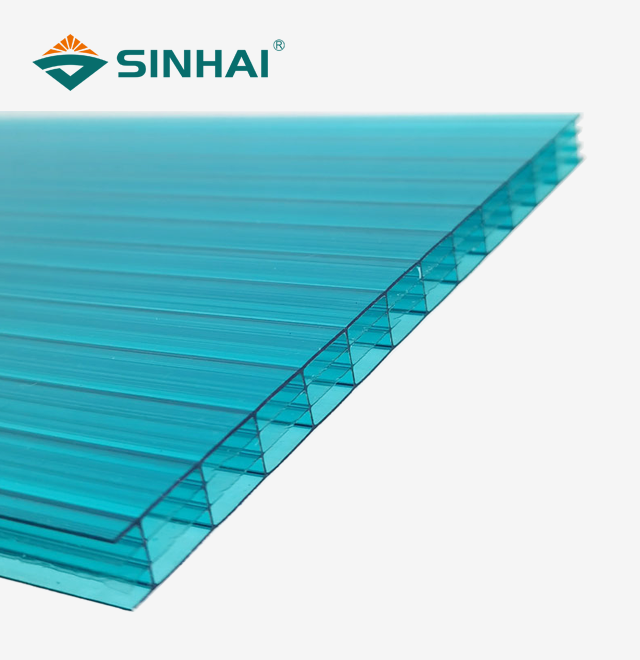
Multiwall Polycarbonate Roof Panels for Greenhouses, Carports & Walkways
Baoding Sinhai Sunboard Manufacturing Co., Ltd.'s multiwall polycarbonate roof panels solve the fundamental trade-off in contemporary roofing: minimising weight while enhancing thermal performance. These panels are made of 100% virgin polycarbonate resin (SABIC or Bayer material) in thickness from 3-12 mm, with U-values from 1.1 to 3.9 W/m²K and a co-extruded UV protection layer of 50-110 microns. Production is implemented at three facilities on 25 lines with the yearly output of around 60,000 tonnes.
What Are Multiwall Polycarbonate Roof Panels?
These panels are made of polyester sheets that were made by co-extrusion. Inside each sheet, there are many flutes or ribs that run parallel to each other from one end to the other. These are long air channels.
These internal spaces do two things: they trap air to slow the movement of heat, and they make the structure stiffer without adding a lot of weight. Because of this, a sheet was made that is about tenth the weight of glass but about 200 times stronger when hit with a standard drop dart.
Multiwall panels don't let light through as a concentrated beam like solid glass does. Instead, they spread light out across the surface. This cuts down on glare and gets rid of hot spots, which is useful in greenhouses, sunrooms, and covered walkways.
Technical Specifications
| Parameter |
Details |
| Thickness |
3 mm – 12 mm |
| Structure |
Twin-wall, Triple-wall, Four-wall (multi-chamber options) |
| U-Value Range |
1.1 – 3.9 W/m²K |
| Impact Strength |
~200× glass, ~30× acrylic |
| Operating Temperature |
−40°C to +120°C |
| UV Protection Layer |
50–110 microns, co-extruded, 1 or 2 faces |
| Cold-Bend Radius |
Minimum 175× panel thickness (e.g., 10 mm panel = 1,750 mm radius) |
| Colors Available |
Transparent, Bronze, Grey, Opal, Lake Blue, Amber, Dark Blue, Silver, Orange, Yellow, or custom |
| Raw Material |
100% virgin PC / SABIC / Bayer / customized |
| Certifications |
ISO 9001:2015, UDEM, KOSHER, CE, RoHS |
| Manufacturing Process |
UV co-extrusion |
| Panel Width / Length |
Customizable |
| Recommended Purlin Spacing (10 mm panel) |
800 mm – 1,000 mm |
Performance Characteristics
Thermal Insulation
When compared to single-layer glass, the multi-chamber air structure lets less heat pass through. A four-wall panel has a U-value of 1.1 W/m²K, which is similar to insulated glazing units. This means that less heat is lost and there is less chance of condensation forming inside.
Resistance to Impact
The internal rib structure spreads the force of impact across several layers. The inner chambers stay together and keep a waterproof barrier even if the outside surface gets hit. Because of this, these screens are a good choice for places where hail is common.
Sun Protection UV
The UV-resistant layer is not put on top of the plastic base; it is co-extruded straight into it. At the material level, it blocks UV radiation, which protects both the panel and whatever is put down below it.
Making cold bends on-site
These multiwall polycarbonate roof panels can be bent on-site without the need for heating tools. The smallest radius that a 10 mm panel can be cold-bent is 1,750 mm, which is enough for arched walks, curved roofs, and greenhouse frames that look like domes.
Performance by Fire
For the most part, they meet the fire ratings for Class B1-s1,d0 (EN 13501-1) or Class A (ASTM D1929). The substance goes out on its own and doesn't make flaming drops when tested in the right way.
Typical Applications
Commercial Greenhouses and Agricultural Structures
The dispersed light transfer and anti-drip treatment choices help keep the growth conditions stable. The light weight of the panels makes the greenhouse frames less stressed.
Covers, canopies, and pergolas for cars
When put up with aluminium or PC H/U profiles and a dry glass system, these panels cover carports and outdoor walks in a way that keeps out the weather. Dust-proof tapes on the ends of the flutes keep the work clean over time.
Industrial skylights and roofs for stadiums
Based on the wind and snow loads in the area, the strength-to-weight ratio lets purlins be spaced 800–1,000 mm apart on 10 mm Four-wall sheets. When compared to heavy glass materials, lighter glazing materials need fewer structure supports.
Patios, walkways, and sheds for homes
The opal and brass finishes let natural light through but make it less clear. This spreads out the light, which is good for sunrooms, verandas, and covered walkways where glare needs to be avoided.
Quality Control
Before it is shipped, each batch of production goes through four checks:
- The Yellowing Index (ΔYI) and Light Transmission (LT) Retention were checked using a rapid weathering program (ISO 4892-2) to make sure they would still work well over time.
- Impact Resistance—checked using the falling dart method (ASTM D3763) to simulate how hailstones would hit in real life.
- UV Layer Thickness—checked by looking at a cross-section under a microscope to make sure the co-extruded layer is at least 50 microns thick.
- The ISO 9001 standards for Dimensional Tolerance and Rib Uniformity are used to make sure that panels fit correctly in aluminium profile systems.
Installation Notes
Seal the edges: Put vent tape that lets air through on the bottom edge of the flutes and solid aluminium tape on the top edge. This lets the moisture inside escape while keeping bugs and dust out of the channels.
Thermal expansion: When it gets hot, polycarbonate grows more than metal. Pre-drill holes that are too big and use EPDM-gasketed screws so that the sheet can move without putting stress on the places where it is attached.
Profile compatibility: The most common way to install a dry glazing system is with H/U aluminium or PC profiles. All sheet thicknesses from 3 mm to 12 mm can be used with it.
Customization and Supply
OEM and ODM production of multiwall polycarbonate roof panels are both possible at Baoding Sinhai. They do CNC cutting, film coating, bending, special-shaped cutting, vacuum forming, and thermoforming, among other things. There are more than 70 free moulds that can be used for different corrugation patterns or panel shapes.
You can change the colours and sheet sizes beyond the standard range.
Usually, regular production orders are finished in seven days or less. Customers in Central Asia can get their orders delivered in about 7 days from the Kashgar production base. For faster delivery in Tashkent and Dushanbe, there are local warehouses that can be used.
You can ship by boat, truck, or plane, and we can help with tasks like clearing customs and delivering goods across borders.
FAQ
Q1: What is the main difference between sunroom panels with four walls and panels with two walls?
A: Three air chamber layers, not one, make up four-wall panels, which make a stronger thermal barrier. This is important for both keeping heat in during the winter and cooling the house during the summer because a lower U-value means less heat moves through the panel in both directions.
Q2: How does the Four-wall construction change the way light passes through?
A: For straight clarity, the extra internal layers make it less clear than Twin-wall. Even, filtered light is created instead of a clear view, which also makes it more private. When controlling glare is more important than optical clarity, this works well in sunrooms and covered patios.
Q3: What happens when heavy hail hits a multiwall panel?
A: Multiple-layered ribs spread contact energy throughout the spaces. Once the top layer is hit, the inner layers stay together and keep the waterproof shield in place. In areas where hail is common, this is a practical advantage over single-layer glazing.
Q4: What is the maximum distance between roof supports, or purlins?
A: A maximum purlin spacing of 800–1,000 mm is usually suggested for a 10 mm Four-wall sheet. Your area's wind and snow load conditions will determine the actual span. Final requirements can be found in your local building code or from a structural expert.
Q5: How do you keep condensation from forming inside the flutes?
A: Insulate the bottom edge with vent tape and the top edge with solid aluminium tape. Condensation doesn't build up inside the panel over time because this setup lets water escape from the channels while keeping dust and vermin out.
Contact Us
Do you have more questions about multiwall polycarbonate roof panels? Send your project specifications to [email protected].