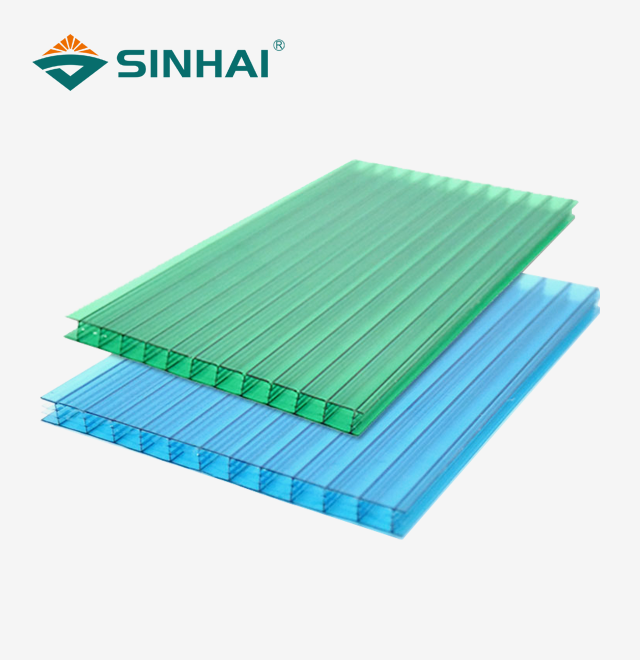
Multiwall Polycarbonate Sheet for Roofing & Glazing — Lightweight, High-Insulation Building Panels
Baoding Sinhai Sunboard Manufacturing Co., Ltd. is a direct maker that has 3 production bases, 25+ production lines, and makes more than 60,000 tonnes of polycarbonate sheets every year. They have been making sheets for more than 30 years. They use a co-extrusion process to make our multiwall polycarbonate sheet, which has a cellular structure on the inside with lots of air pockets to keep heat in. It comes with 2 walls, 3 walls, or 4 walls, and the width can be anywhere from 3mm to 12mm (or up to 16mm on request). That's between 65% and 82% of light getting through. It meets ISO 9001:2015, CE, RoHS, and UDEM standards.
What Is a Multiwall Polycarbonate Sheet?
To make a multiwall polycarbonate sheet, which is a rigid polymer panel, you use the extrusion method. Longitudinary ribs connect different layers. It keeps air in the channels so that there is a built-in thermal barrier.
It directly solves common building problems like too much dead weight from glass, heat loss in greenhouses, and surface damage in places where hail is common. It's light, strong, and good at keeping heat in because it's made up of cells.
The air holes inside are better at keeping heat in than thick sheets, which is something that single-layer materials can't do. As long as it lets enough natural light in, the frame stays strong. This makes it useful when both saving energy and having a bright screen are important.
Key Technical Specifications
| Parameter |
Details |
| Thickness |
3mm – 12mm (up to 16mm on request) |
| Wall Structure |
2-wall, 3-wall, 4-wall |
| Light Transmission |
65% – 82% |
| UV Coating |
Co-extruded UV layer, 50–110 microns, 1 or 2 faces |
| Material |
100% virgin resin; SABIC / BAYER import options available |
| Colors |
Transparent, Bronze, Grey, Opal, Lake Blue, Amber, Dark Blue, Silver, Orange, Yellow, or custom |
| Thermal Expansion Coefficient |
0.065 mm/m°C |
| Warranty |
10 years |
| Certifications |
ISO 9001:2015, CE, RoHS, UDEM |
Wall Structure Options — Which One Do You Need?
The lightest and least expensive option is 2-Wall (Twinwall). Perfect for coverings like canopies, pergolas, and awnings where keeping heat in is not the main concern.
Tri-Wall: Two layers of air chambers. A sensible mix between stiffness, weight, and insulation. widely utilised for coverings over greenhouses, windows, and hallways.
Fourwall: Three layers of air tanks for better heat performance. Sunrooms, stadium roofs, and projects in cold climates where saving energy is important should use this material.
More walls make the thermal barrier stronger, but they also make the panel stiffer. Choose based on the weather where you live, the distance between the spans, and the amount of protection you need.
Performance Advantages
Multiple air chambers provide thermal insulation.
A surplus of insulation is provided by each air route. For the same amount of space, more chambers mean lower U-value and lower heating and cooling costs.
Light Permeance: 65% to 82%
Interiors are bright without being too bright. As opposed to direct sunlight, the multi-layer structure creates a soft, diffused light effect that works well in greenhouses and business spaces.
Co-Extrusion UV Protection
As opposed to being added as a coating, the UV inhibitor layer is co-extruded directly into the sheet surface. Therefore, the yellowing and breaking down of polymers that happen with long-term UV radiation are stopped. Sheets come with a 10-year warranty.
Impact Protection
Impact energy is absorbed by the multi-layered internal structure. Damage from hail doesn't affect the inner layers, so water is less likely to get in. Especially in storm-prone places, this is a useful benefit over glass and plastic.
Lightweight—only tenth as heavy as glass
More lightweight panels mean less heavy support structures, less expensive shipping, and easier handling on-site. No lifting equipment is needed for two people to handle a full-size sheet.
Typical Applications
These panels are used on many types of buildings:
- Glass greenhouses let in a lot of light, keep heat in, and have extra anti-drip treatments to keep plants from getting wet.
- Structures with a lot of spans and stadium roofs—The main structure is lighter when the strength-to-weight ratio is high.
- Skylights and day lighting panels let light in without putting people directly in the path of UV rays.
- Lightweight, waterproof, and easy to set up are covers, pergolas, and awnings. Corridors, sound barriers, and walls offer multi-wall stiffness with clear sight.
- Solar screens and covers for pools that block UV rays and don't get wet
Material Quality & Customization
Multiwall polycarbonate sheet filters can be made from 100% brand-new polycarbonate resin. When tighter material requirements are needed, foreign SABIC or BAYER plastic can be used. Using UV co-extrusion, both choices go through the same steps.
Customisation choices include:
- Colours: 10 standard colours plus personalised choices
- Single-face or dual-face UV treatment, 50–110 microns
- Size: CNC cutting to your exact instructions
- Special processing: vacuum making, thermoforming, bending, and cutting into various shapes
- OEM/ODM: Provides full private label and design services
Installation Considerations
Polycarbonate's thermal expansion coefficient is 0.065 mm/m°C. To keep the sheet from buckleing, you need to make sure there is enough space in the frame and use fixing holes that are sufficiently long.
Always properly seal the ends of the flutes: use anti-dust venting tape at the bottom opening and solid aluminium tape at the top. Keeping bugs and dust out while letting water drain is possible.
It is suggested that the maximum distance between purlins for a 10mm 4-wall sheet be between 800mm and 1000mm, but this depends on the wind and snow load in the area. Cleaning products that are alkaline can damage the surface, so only use pH-neutral ones.
FAQ
Q1: What is the main reason why a 4-wall sheet is better for a sunroom than a 2-wall sheet?
A: The four-wall frame has three layers of air tanks that make the heat shield stronger. It keeps your sunroom cooler in the summer and warmer in the winter than a two-wall sheet.
Q2: Does the sheet look cloudy because it has four walls?
A: Because it has more internal layers, it makes direct transparency less clear, but it also makes light more even and diffused, which is better for privacy and lessens harsh shadows.
Q3: Does the 4-wall sheet weigh more and be harder to put up?
A: A 2-wall sheet is a bit lighter than this, but it's still only about 1/10 the weight of glass. It can be moved by two people without the need for moving gear, and it works with the same aluminium profile systems as regular sheets.
Q4: How does a product deal with big hail?
A: The impact is absorbed by the multi-layered structure inside. The inner layers stay together even if the top layer is hit, so water doesn't have to leak out. This is better than smaller single-wall panels in places where hail is common.
Q5: How far apart should the purlins be for a 10 mm 4-wall sheet?
A: We suggest a maximum span of 800mm to 1000mm, but this depends on how much wind and snow there is in the area.
Q6: Why do polycarbonate sheets turn yellow sometimes? What can be done to stop this?
A: UV light breaks down the material, which makes it turn yellow. To keep the sheets clear during the warranty period, a co-extruded UV inhibitor layer (50–110 microns) is built into the surface and not added as a topcoat.
Contact Us
Do you have more questions about multiwall polycarbonate sheet? For quotes or samples, contact us at [email protected].