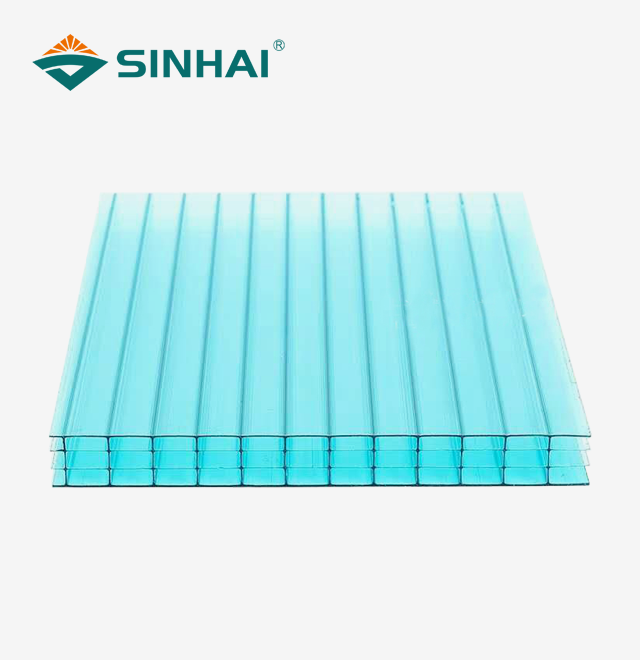
Multiwall Polycarbonate Sheets for Roofing, Greenhouses & Glazing
Multiwall polycarbonate sheets have a thermoplastic structure with multiple layers and sealed air channels inside. They offer thermal insulation, resistance to impact, and controlled light diffusion all in one panel. The Baoding Sinhai Sunboard Manufacturing Co., Ltd. makes these panels across three factories with more than 25 production lines and more than 60,000 tonnes of output every year. The panels come in thicknesses ranging from 3mm to 12mm, with U-values ranging from 1.0 W/m²K to 3.9 W/m²K and light transmission ranging from 30% to 82%.
What Sets These Panels Apart?
The structure of internal ribs is both a way to reduce weight and a way to keep heat in. In all thicknesses, the vertical and lateral bars make tight air pockets that keep heat in better than single-pane glass or plastic.
At 50–110 microns, the UV protection layer is co-extruded directly onto one or both of the panel faces. Because it bonds to the surface during the extrusion process, it doesn't come off easily and keeps doing its job as a protector even after years of being exposed to UV light outside. This lowers the chance of yellowing and surface cracking.
All parts are made with plastic resin that is brand new. You can choose between standard raw material, foreign SABIC resin, or BAYER resin, depending on the needs of your project.
Product Specifications
| Parameter |
Details |
| Thickness |
3mm – 12mm |
| Structure Types |
Twinwall, Triple Wall, Fourwall, X-structure, Honeycomb |
| U-Value Range |
1.0 – 3.9 W/m²K |
| Light Transmission |
30% – 82% |
| Service Temperature |
-40°C to +120°C |
| UV Protection Layer |
50–110 microns, co-extruded, 1 or 2 faces |
| Colors Available |
Transparent, Bronze, Grey, Opal, Lake Blue, Amber, Dark Blue, Silver, Orange, Yellow, or custom |
| Material Options |
100% virgin / SABIC / BAYER / customized |
| MOQ |
500 m² |
| Lead Time |
7–15 working days |
| Certifications |
ISO 9001:2015, SGS, CE, RoHS, UDEM, KOSHER |
Key Performance Properties
Thermal Insulation
It takes 3.9 W/m²K to heat or cool a 6mm multiwall polycarbonate sheets twinwall panel. As little as 1.0 W/m²K can be reached by a 10 mm fourwall or multi-layer structure, which is a clear improvement over regular single-pane glass. If you need to control the temperature all year, this thermal performance is useful for greenhouses, sunrooms, and business buildings.
Impact Strength
The internal structure is made up of many layers, which absorb and spread contact force across the panel surface. This helps protect the building from damage and water entry in places where hail is common. This is an important thing to think about when comparing these panels to glass alternatives in both agricultural and architectural settings.
Spreading of light
Instead of sending light as a straight line, the arrangement of the cells spreads it. This scattering helps spread light more evenly across the growing area in greenhouses by reducing hot spots in certain areas.
Protection from fire and chemicals
As per EN 13501-1, panels usually have a fire rating of Class B-s1, d0. Also, they can stand up to many diluted acids and alcohols, which means they can be used in some industrial settings.
Typical Applications
In business, farming, and industrial projects, multiwall polycarbonate sheets are used.
- Spreading light and keeping heat in lessen the need for heating in the winter on greenhouse roofs.
- Lightweight panels lower the load on structures while letting in natural light for industrial skylights and warehouse roofs.
- Multiple layers of impact resistance keep hail and other objects from breaking through carports and canopies.
- Fourwall structures, like sunrooms and pergolas, keep the inside of a building warmer or cooler throughout the year.
- Thick multi-wall panels are used for both architectural exterior and internal walls. They look good and keep heat out.
- Curtain walls, sound barriers, and swimming pool structures that can handle tough outdoor and semi-outdoor settings
Customization and Supply Options
Panels can be ordered in standard sizes or in any size that you need. To meet the needs of each project, the production team can do CNC cutting, special-shaped cutting, and film finishing.
There are clear, bronze, green, opal, lake blue, amber, dark blue, silver, orange, and yellow colours to choose from. You can ask for colours that don't exist yet.
Along with panels, structural profiles, fittings, and hardware accessories are supplied, so you don't have to coordinate with multiple suppliers. OEM and ODM services are also available, such as help with 3D modelling, folding, vacuum forming, and thermoforming for specific uses.
Quality Control and Certifications
As a part of the extrusion process, every sheet goes through a 100% online thickness check and UV layer check during production. Raw materials that come in and finished panels that go out are also tested for their ability to withstand impact, light, fire, and weathering.
The Chinese National Standard for Plastics—Polycarbonate Sheets was mainly written by Baoding Sinhai. It was made public on September 29, 2024, and went into effect on April 1, 2025. Being involved in writing national standards means having a direct impact on setting standards for product quality across the business.
There are currently ISO 9001:2015, CE, RoHS, UDEM, SGS, and KOSHER certifications.
Logistics and Delivery
Standard orders are usually finished between 7 and 15 business days. Customers in Central Asia can get goods delivered to Middle Eastern countries in about 7 days thanks to the Kashgar production base. Warehouses in Tashkent and Dushanbe make regional fulfilment go more quickly.
Whether the shipment is by boat, truck, or air, logistics teams are in charge of clearing customs and making sure all the necessary paperwork is done for crossing borders.
FAQ
Q: What is the main thermal difference between Twinwall and Fourwall panels?
A: Fourwall panels have three sealed air chambers instead of one, which creates a stronger thermal barrier. This makes them better suited for applications where year-round temperature stability matters — such as sunrooms or enclosed agricultural structures.
Q: Does the Fourwall structure affect light transmission?
A: It does reduce direct transparency compared to Twinwall because of the additional internal layers. The result is diffused, even light rather than direct beam transmission. This characteristic also provides a degree of visual privacy, which is useful for office partitions and certain architectural applications.
Q: How does Fourwall compare to Twinwall in terms of weight and installation?
A: Fourwall panels are slightly heavier but still significantly lighter than glass. They are compatible with standard aluminum profile systems used for polycarbonate sheet installation, so no special tools or separate hardware systems are required.
Q: What purlin spacing is recommended for a 10mm Fourwall sheet?
A: For 10mm Fourwall panels, a maximum span of 800mm to 1000mm is typically recommended, though the appropriate spacing depends on your local wind load and snow load conditions.
Q: What material grades are available?
A: You can specify 100% new virgin polycarbonate, premium imported SABIC resin, or BAYER resin. Custom material specifications can also be accommodated based on project performance or compliance requirements.
Q: Are structural profiles and fittings available alongside the panels?
A: Yes. Baoding Sinhai supplies structural profiles, fittings, and hardware accessories together with the panels, so you can source components from a single point of contact.
Contact Us
Send your project specifications to [email protected] to request a quote. We supply multiwall polycarbonate sheets for projects of all scales worldwide.