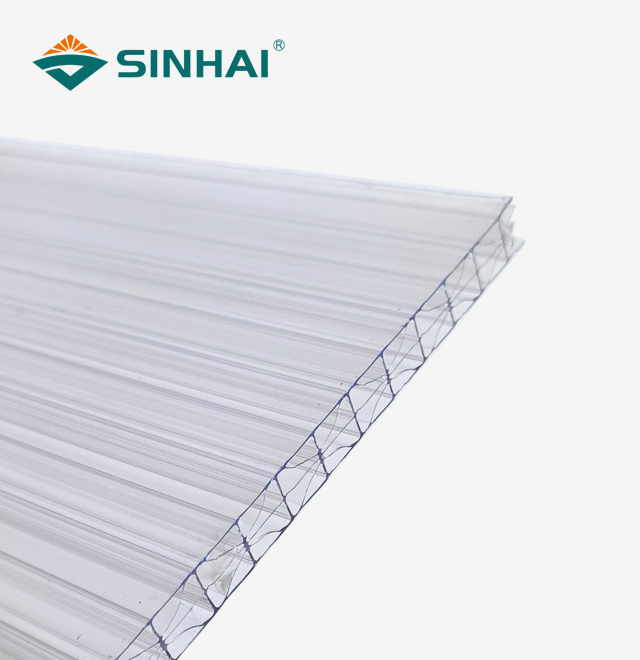
Polycarbonate Multi-Wall Sheet for Roofing & Glazing
Since more than 30 years ago, Baoding Sinhai Sunboard Manufacturing Co., Ltd. has been making polycarbonate panels. The company has more than 25 production lines spread out over 3 production bases and makes more than 60,000 tonnes of goods every year. Each polycarbonate multi-wall sheet is made from 100% new plastic, or if needed, foreign SABIC or BAYER material, and a 50–110 micron UV protected layer is added at the same time. You can get sheets that are 3mm to 12mm thick, let up to 82% of light through, and can be used in temperatures ranging from -40°C to +120°C.
What Is a Polycarbonate Multi-Wall Sheet?
A polycarbonate multi-wall sheet is a thermoplastic panel that has been extruded and has several layers inside that are joined by ribs that run vertically or diagonally. Because these ribs are sealed, they make air pockets that act as a thermal barrier and slow the flow of heat from the inside to the outside.
Compared to glass, this frame is much more resistant to pressure and only weighs a tenth as much. That lowers the load on steel or aluminium frames and makes it easier to handle on-site.
The curved internal design also spreads out light that comes in. This makes light that is even and doesn't reflect, which is helpful in places like greenhouses, skylights, and covered walkways where direct hotspots are a problem.
Key Technical Specifications
| Parameter |
Details |
| Thickness |
3mm – 12mm |
| Structure |
Multi-wall ribbed (twin, triple, four-wall options) |
| Light Transmission |
Up to 82% |
| UV Coating |
Co-extruded, 50–110 microns (1 or 2 faces) |
| Working Temperature |
-40°C to +120°C |
| Service Life |
10–20 years |
| Impact Resistance |
Substantially higher than glass (approximate, varies by thickness) |
| Colors Available |
Transparent, Bronze, Grey, Opal, Lake Blue, Amber, Dark Blue, Silver, Orange, Yellow, Custom |
| Raw Material |
100% virgin PC / SABIC / BAYER / Customized |
| Certifications |
ISO 9001:2015, CE, RoHS, UDEM |
Material & UV Protection
All of the polycarbonate resin in each sheet is brand new. For projects that need the highest quality, you can get imported SABIC or BAYER material.
The UV protection layer is put on by co-extrusion instead of coating the surface. This sticks a 50–110 micron UV-blocking layer right to the sheet's surface, so it can't come apart. It blocks dangerous ultraviolet light, which helps the sheet stay clear and not turn yellow when used outside.
Put the sheet down so that the side that is marked with UV light faces the sun. This is the most important thing you can do to protect eye performance in the long run.
Structural Performance & Thermal Insulation
The curved structure with multiple walls does more than just cut down on weight. Each sealed air pocket between the ribs acts as an insulating layer, slowing the transfer of heat.
A four-wall sheet has three separate air pockets that keep heat in better than a standard twin-wall sheet. This means it can be used for sunrooms, heated greenhouses and building envelopes that need to be sensitive to the weather.
For a 10mm four-wall sheet, the maximum distance between purlins should be between 800mm and 1000mm, but this depends on the wind and snow loads in the area. With a bigger span, you don't need as many support members, which can save you money on both materials and labour.
Applications Across Industries
In a variety of construction and industrial projects, polycarbonate multi-wall sheets are used:
- Commercial greenhouses: Plants thrive on consistent temperatures and evenly diffused light, whatever the weather.
- Industrial skylights and roofing—Natural light is an advantage to warehouses and other big structures, as well as the capacity to resist wind and snow loads.
- Canopies, Awnings and Pergolas: Lighter panels need less support than heavier panels, but still provide weather protection.
- Interior Partitions and Corridors The transparent style and soundproofing create individual sections that seem to be joined.
- Swimming Pool Covers & Curtain Walls—Water, UV light and temperature resistant for long-lasting performance in damp areas.
With a linear thermal expansion rate of 0.065 mm/m°C, the material can withstand cycles of heating and cooling outside without cracking or bending.
Customization & OEM Services
OEM colours, custom sheet sizes, surface printing, CNC precise cutting, film finishing, bending, special-shaped cutting, vacuum forming, and thermoforming are some of the ways that you can make your product unique. There are more than 70 free moulds for corrugated profiles that give designers more options without having to pay for extra tools.
Panels that aren't normal sizes or are smaller are shipped in cartons to keep them safe. Customers who buy in bulk are put on pallets.
Quality Control Process
Sinhai checks the quality of its products three times: when it receives raw materials, when it watches the production line, and when it delivers the finished product.
Key tests include checking the UV layer thickness against a 50-micron standard, making sure the sheet can withstand impact with falling dart tests according to ISO 6603, measuring light transmission and haze with a spectrophotometer according to ASTM D1003, and checking the Yellowness Index according to ASTM E313 to make sure the sheet stays clear to the naked eye for the full rated service life.
The sheet's weight per square metre and the placement of the ribs are also checked. Not having enough grammage directly lowers the panel's ability to hold weight and can shorten its life.
Packaging & Logistics
| Order Type |
Packaging |
| Small sizes |
Carton |
| Bulk orders |
Pallet |
| Standard delivery |
~7 working days |
| Central Asia delivery |
~7 days via Kashgar base |
Sinhai supports sea, truck, and air freight. Overseas warehouse resources in Tashkent and Dushanbe serve Central Asian customers with faster local access and reduced transit time.
FAQ
Q1: What is the main benefit of a four-wall sheet over twin-wall for a sunroom?
A: Thermal insulation. The four-wall structure creates three separate air chambers, forming a stronger thermal barrier. A sunroom built with four-wall panels generally stays cooler in summer and retains heat better in winter compared to twin-wall.
Q2: Does the four-wall structure affect clarity?
A: It reduces direct transparency compared to twin-wall due to the additional internal layers. The visual effect is diffused, soft light transmission — uniform in appearance, with better privacy and reduced harsh shadow lines.
Q3: Is the four-wall sheet difficult to handle on site?
A: It is slightly heavier than twin-wall, but still far lighter than glass at a comparable thickness. It fits standard aluminum profile systems used for other sheet types, so no special installation tools are required.
Q4: How does a multi-wall sheet perform against hail impact?
A: The layered internal structure absorbs impact across multiple surfaces. Even if the outer face is struck, the inner layers can remain intact, reducing the risk of water ingress. Performance in specific hail conditions depends on sheet thickness and structure — consult the technical datasheet for your selected product.
Q5: What purlin spacing should I use for a 10mm sheet?
A: For a 10mm four-wall panel, a maximum purlin spacing of 800mm–1000mm is typically recommended. The appropriate spacing depends on local wind and snow load conditions.
Q6: How do I prevent yellowing over time?
A: Install the sheet with the UV-protected face toward the sun. The co-extruded UV layer is designed to filter harmful ultraviolet radiation, helping the product stay clear and resist yellowing or brittleness across its rated 10–20 year service life.
Contact Us
Do you have more questions about polycarbonate multi-wall sheet? Send your project requirements to [email protected] for product details, specifications, or a quote.