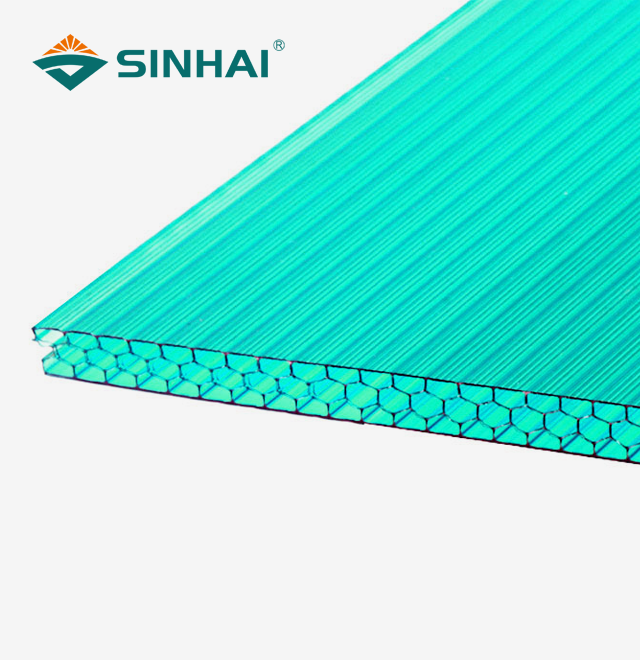
Honeycomb Polycarbonate Sheet — Hexagonal Core Roofing & Glazing Panel
A honeycomb polycarbonate sheet is a structural glazing panel with a hexagonal internal cell architecture, similar to the shape of a beehive in nature. It is available in thicknesses of 8 to 16 mm, made from 100 % virgin polycarbonate resin or quality SABIC/Bayer material, and offers 60 to 80 % light transmission with a smooth, diffused output. The hexagonal core distributes loads in several directions rather than one axis for a high strength-to-weight ratio suitable for big span roofs, greenhouses and architectural windows.
What Makes the Honeycomb Structure Different?
Standard twin-wall or triple-wall sheets have vertical ribs. Those ribs are good under a single axis of loading, but may not be as good under multi-directional wind uplift or unequal snow pressure.
The honeycomb core doesn’t operate like that. Its inner walls are hexagonal, spreading the stress across a greater variety of loading orientations. This enables the panel to provide true stiffness with no weight penalty – something that flat or ribbed panels are fundamentally less well equipped to do.
For large-span construction this implies a light-weight panel that can sustain structural performance in a variety of weather situations without the need for the massive cross-sections required for heavier materials.
Key Specifications
| Parameter |
Details |
| Thickness |
8mm – 16mm |
| Structure |
Hexagonal honeycomb core |
| Light Transmission |
60% – 80% |
| UV Coating |
UV co-extruded, 50–111 micron (1 or 2 faces) |
| Raw Material |
100% virgin PC resin / SABIC / Bayer / customized |
| Colors Available |
Transparent, Bronze, Grey, Opal, Lake Blue, Amber, Dark Blue, Silver, Orange, Yellow, or customized |
| Warranty |
10 years |
| Certification |
ISO 9001:2015, CE, RoHS, UDEM |
Performance Characteristics
Thermal Insulation
Making a temperature buffer between the inside and outside surfaces, the hexagonal cells of the honeycomb polycarbonate sheet trap air inside the panel body. Some places where this is used—growhouses, sports halls, and commercial buildings with lots of glass facing direct sunlight—see less heat transfer.
Reduced Sound
While normal empty ribs stop sound waves from travelling, the split hexagonal air pockets stop them in a different way. Because of this, the panel can be used as a noise barrier on highways and inside places where keeping noise levels low is important.
Strength of Impact
Impact energy doesn't stay in one place on the screen because of the honeycomb shape. Instead, it's spread out across the surface. So, it works well in places where hail or heavy snowfall is likely to happen.
Movement of Light
The panel spreads natural light evenly without making glare or bright spots because it lets 60% to 80% of light through. When uniform light is needed for design reasons, this property comes in handy for LED-backlit signs and architectural installations.
Typical Applications
Industrial High-Span Roofing
There is a need for screens that are strong, light, and good at letting light in at airport hubs, train stops, and sports facilities. Even though the overall roof load is manageable, the hexagonal core structure handles wind uplift and snow pressure.
Greenhouses with specific needs
Because temperatures change a lot in some places, keeping the climate stable inside helps plants grow in the same way every time. Inactive heating and cooling systems are used less because the hexagonal cells create a temperature buffer.
Signage and the Inside of Architecture
When natural light and privacy are both needed in an office partition, this panel is used. It is the hexagonal interior shape of LED-backlit display screens that helps spread light widely and stops the hot-spot effect that can happen with regular clear sheets.
Material and Customization Options
There is a UV-protective layer bonded directly to the surface of each panel during production using UV co-extruded technology. The UV layer won't peel off with this method, and the surface won't turn yellow or break down too quickly.
As well as standard colours, you can ask for tints that are made just for you. CNC cutting, folding, special-shaped cutting, and film finishing are some of the services that are available. We can make sheets in both standard sizes and custom sizes for your project. Please contact us to talk about lead times for your purchase volume.
Three production bases run by Baoding Sinhai Sunboard Manufacturing Co., Ltd. have more than 25 production lines and produce more than 60,000 tonnes of honeycomb polycarbonate sheet and other goods every year. This means that they can handle both large orders and mixed-containers.
Installation and Maintenance Notes
In degrees Celsius, polycarbonate expands linearly by 0.065 mm/m. Utilise fixing holes that are too big and EPDM covers instead of hard screws to allow for heat movement. In order to keep stress cracks from happening when cold bending on-site, the bend radius must be at least 175 times the thickness of the sheet.
Use anti-dust breathable vent tape on the lower edges and solid aluminium tape on the upper edges to keep the inside from getting wet and starting mould growth. Do not use any other detergents for regular cleaning. To protect the layer, you should stay away from rough cleaners and alkaline substances.
FAQ
Q1: Is "Honeycomb" a marketing term, or does the structure offer a measurable structural difference?
A: The hexagonal matrix distributes load across multiple directions, whereas vertical ribs are primarily optimized for loads along a single axis. This structural difference is the reason the panel is specified for applications where multi-directional stress — such as combined wind uplift and snow pressure — is a design consideration.
Q2: Can it be used for indoor office partitions?
A: Yes. The panel allows natural light to pass through while providing visual privacy, and the internal hexagonal geometry creates a distinctive visual character that suits architectural interior applications.
Q3: Is it more expensive than standard multi-wall sheets?
A: The more complex extrusion process does result in a higher unit cost compared to standard twin-wall or triple-wall sheets. For projects where structural performance, impact resistance, or light diffusion quality are primary requirements, the specification difference may justify the cost. Contact us for pricing based on your project quantities.
Q4: Will the honeycomb pattern become visible or dirty-looking over time?
A: The hexagonal pattern is the internal structure of the panel, not a surface treatment. Because light scatters through the cell walls, minor surface dust and shallow scratches are less visually prominent than they would be on standard clear sheets.
Q5: What is the expected service life in high-UV environments?
A: The panel carries a 10-year limited warranty. The UV co-extruded coating — available in 50–111 micron thickness — is bonded during production rather than applied as a separate layer, which contributes to consistent UV protection over the warranty period.
Contact Us
Do you have more questions about honeycomb polycarbonate sheet? Request a quote or product samples for your project — email [email protected].