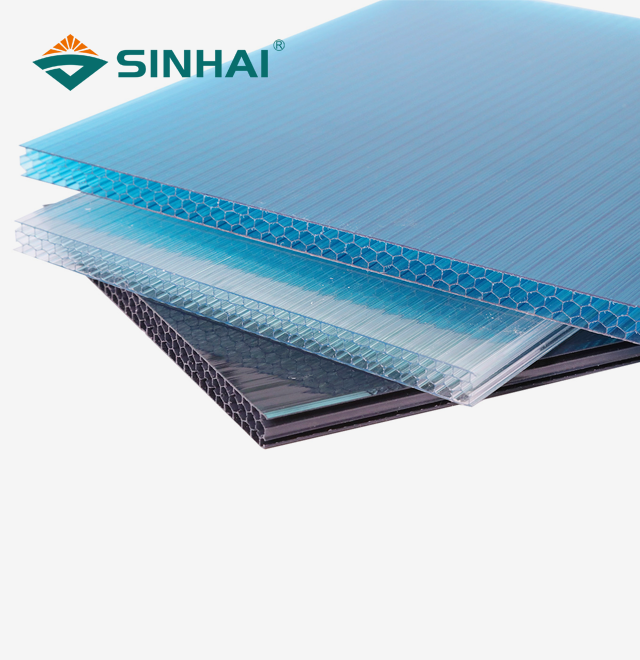
Polycarbonate Honeycomb Sheet for Skylights, Curtain Walls & Architectural Glazing
This panel is different from other multi-wall sheets because its internal geometry is hexagonal. The structure cell spreads the load across six walls at once, unlike twin-wall or triple-wall shapes with vertical ribs. It can handle wind lifting, snow pressure, and impacts from all directions. The polycarbonate honeycomb sheet is a useful alternative to heavy glass systems for builders and workers working on large-scale daylighting projects because it is very stiff when bent and doesn't weigh much. It can be used in roofs, curtain walls, and skylights.
What Makes the Hexagonal Structure Different?
Standard twin-wall or triple-wall sheets use vertical ribs that carry loads well in just one direction. The hexagonal honeycomb distribution distributes the stress to six interior walls at the same time, offering isotropic stiffness, that is, the same rigidity regardless of the direction of the load.
Wind uplift, snow loads, impact pressures – they’re everywhere, not just down from above. For high-span roofing at airport terminals, sports stadiums and railway stations, polycarbonate honeycomb sheet is a suitable option due to its multi-directional load distribution.
Technical Specifications
| Parameter |
Details |
| Thickness |
8 mm – 16 mm |
| Cell Structure |
Hexagonal honeycomb (multi-wall) |
| Material |
100% virgin PC resin / SABIC / Bayer (customizable) |
| UV Coating |
Co-extruded UV layer, 50–111 microns (single or double face) |
| Colors |
Clear, opal, bronze, grey, lake blue, amber, dark blue, silver, orange, yellow, or custom |
| MOQ |
500 m² |
| Lead Time |
7–15 working days |
| Expansion Coefficient |
0.065 mm/m°C |
| Cold Bending Radius |
≥ 175× sheet thickness |
| Certifications |
ISO 9001:2015, CE, RoHS |
Key Product Features
High Rigidity, Low Weight — No Visible Rib Lines
The hexagonal air pockets trap stagnant air between interior walls, decreasing overall panel weight while retaining bending stiffness. By comparison, glazed facades have no apparent surface rib lines from the exterior compared to normal ribbed sheets therefore providing a cleaner visual finish.
UV Co-Extrusion Technology
The UV protection layer is co-extruded directly onto the surface of the sheet and will not peel or wash off. Resistant to yellowing and surface damage in extended sun exposure with 50 - 111 microns on one or both sides.
Thermal Insulation Properties
The sealed hexagonal cells are more efficient in trapping air than the open-channel ribs, which reduces the heat transmission across the panel. This is important for roofing and glazing applications when heat management is required as part of the design.
Sound Performance
The transmission of sound waves is interrupted differently by the hexagonal air cells than by straight parallel ribs. This structural feature increases the acoustic attenuation, therefore making the panel suited for noise sensitive applications, such as highway barriers and office walls.
Where It Gets Used
Industrial and Commercial Roofing
This panel is used for big span daylighting in airport terminals, railway stations and sports facilities. Its hexagonal design allows natural light to filter through the interior areas and can withstand large snow loads and significant wind uplift.
Skylights & Curtain Walls
With its smooth surface finish and diffused light transmission, polycarbonate honeycomb sheet is a suitable complement for architectural skylights and curtain wall systems where performance and visual quality are desired.
Interior Office Partitions & Signage
The hexagonal design provides geometric visual depth and a light dispersion effect that lowers LED hot spots in backlit signs. It permits places to be bright with natural light, while providing visual seclusion.
Roofs for Greenhouses
The layer of honeycomb cells functions as a thermal barrier between the external environment and the interior growth zones, crucial in projects for agriculture in cold climate or high altitude.
Customization and Supply Options
For this product you may define:
- Raw material grade: ordinary virgin PC, SABIC or Bayer resin.
- UV coating: one or two sides, 50-111 microns
- Colour : normal range or completely custom
- cnc cutting to project sizes
- OEM/ODM packaging and branding
Baoding Sinhai Sunboard Manufacturing Co., Ltd. has over 30 years of expertise in the production of polycarbonate and possesses ISO 9001:2015, CE and RoHS certificates. Standard orders are sent in approx. 7-15 working days depending on volume & specification of the order.
Installation Notes
Thermal Expansion Oversized fastening holes and EPDM gaskets to allow panel movement. The linear expansion coefficient is 0.065 mm/m°C — this tolerance is needed for any long-run installation.
Cold Bending On-Site: The panel may be cold-bent on-site. To prevent stress cracking, ensure the bending radius is at least 175 times the sheet thickness.
Preventing Internal Condensation Use anti-dust vent tape on lower panel edges, solid aluminium tape on top edges. This allows moisture to escape, but also keeps dust and insects out of the cell structure.
Cleaning: Use only a neutral pH detergent. The panel is resistant to most organic and inorganic acids. It is susceptible to abrasive cleansers and alkaline materials. Do not use solvents or abrasive spray.
FAQ
Q1: Is "honeycomb" just a marketing label, or does the structure perform differently from standard sheets?
A: The hexagonal matrix distributes load across six walls simultaneously, whereas vertical ribs handle force primarily in one axis. This structural difference is measurable in bending stiffness tests and is the reason honeycomb panels are specified for demanding applications such as high-wind roofing.
Q2: Can these sheets be used for indoor office partitions?
A: Yes. The hexagonal structure provides geometric visual depth and diffuses light between spaces, which suits office partition and backlit signage applications where both privacy and daylighting are design goals.
Q3: Does the honeycomb structure reduce noise?
A: The hexagonal air pockets interrupt sound wave transmission more effectively than straight parallel ribs. This makes the panel suitable for installations where acoustic performance is a consideration, such as highway barriers or enclosed office environments.
Q4: Is the honeycomb sheet more expensive than standard multi-wall sheets?
A: There is a price premium due to the more complex extrusion process. For projects where structural performance, aesthetics, and service life are primary requirements, the cost difference is typically justified by reduced maintenance and replacement frequency.
Q5: Will the internal pattern become visible or look dirty over time?
A: The hexagonal pattern is the internal cell structure itself — not a surface print or coating. Light scattering through the cell walls makes minor surface dust and fine scratches less visible than on clear standard sheets.
Q6: What is the expected service life in high-UV environments?
A: With a co-extruded UV coating of 50–111 microns, the product carries a 10-year limited warranty under standard conditions.
Contact Us
Do you have more questions about polycarbonate honeycomb sheet? Send your project specifications or sample requests to [email protected].