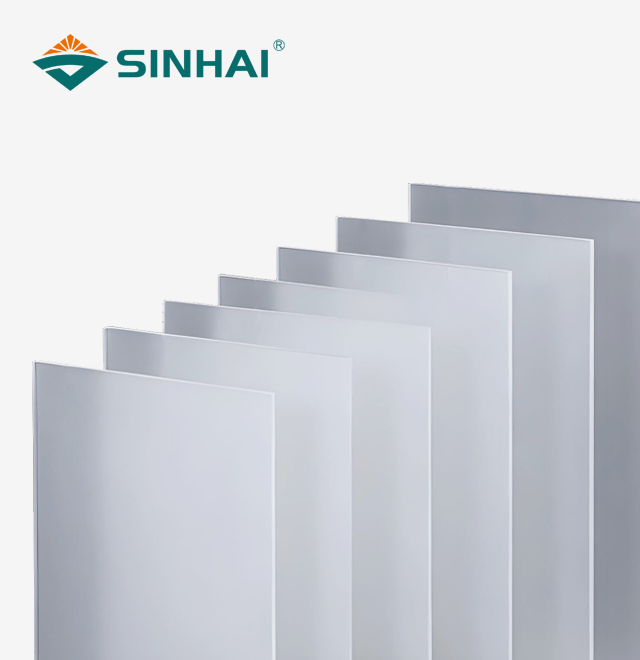
Light Diffusion Polycarbonate Sheet for LED Lighting & Architectural Glazing
Baoding Sinhai Sunboard Manufacturing Co., Ltd. is a direct maker that has been making polycarbonate sheets for more than 30 years. They have 3 production bases, 25+ production lines, and more than 50,000 m² of plant space that they use to make more than 60,000 tonnes of sheets every year. Our light diffusion polycarbonate sheet is made from 100% new Bayer/Sabic PC resin. It comes in thicknesses ranging from 0.95 mm to 23 mm, lets 70% to 90% of light through, has a haze range of 50% to 90%, and has a 50 μm UV co-extrusion layer that blocks 98% to 100% of UV light.
What Is a Light Diffusion Polycarbonate Sheet?
Spreading agents, which are usually organic silicone or acrylic polymers, are added straight to the PC resin matrix to make a light diffusion polycarbonate sheet. For example, frosted or sandblasted surfaces use surface roughness to scatter light, but this is structurally different.
Inside the molecules, reflection and scattering cause the spread. A smooth, even surface output is made across the panel from point sources of light like LED strips or bulbs. In cases where visible LED hot spots, uneven brightness, or glare are a problem, this material can be used.
There is a way to change the ranges of light transmission and haze without having to accept them as fixed trade-offs. This is done by changing the refractive index relationship between the PC matrix and diffusion particles.
Key Technical Specifications
| Parameter |
Value |
| Product Form |
Solid / single-layer smooth sheet |
| Thickness |
0.95–23 mm (common: 1.5 / 2 / 3 / 4 / 6 / 8 / 10 / 12 mm) |
| Effective Width |
Max 2,100 mm (1220 / 1560 / 1830 / 2100 mm) |
| Length |
Unlimited, cut to order |
| Resin |
100% virgin Bayer / Sabic PC |
| UV Co-extrusion Layer |
50 μm (blocks UV below 380 nm) |
| Anti-UV Rate |
98%–100% |
| Light Transmission |
0%–90% (varies by color and surface finish) |
| Haze Value |
50%–90% |
| Impact Strength |
850 J/m |
| Service Temperature |
-40°C to +120°C |
| Cold Bend Radius |
≥175× sheet thickness |
| Fire Rating |
B1 (GB 8624) / UL94 V-2 |
| Warranty |
10–20 years |
| Certifications |
ISO 9001:2015 / SGS / CE / RoHS |
| Packing |
PE protective film + wooden pallet / crate |
Optical Performance: Haze and Transmission
Most diffusion materials make a choice between how much light they let through and how regular they are. Higher haze usually lowers transmission, which makes it less useful in LED and building settings where both values are important.
You can choose a haze range of 50% to 90% for these sheets, and the light transmission stays at 70% to 90%. Transmission goes down a little as the thickness goes up, and haze goes up a little, but both stay within useful ranges for normal thicknesses.
This means that the material can be used for window panels, LED tube covers, panel light diffusers, and slim light boxes without having to choose between brightness and comfort.
Applications
Professional LED Lighting
This is what is used to cover LED tubes, panel light diffusers, and street lamp covers. At working temperatures up to +120°C, the sheet can handle heat stress and light up the whole panel surface evenly.
Digital signs and business displays
It is used in backlit advertising displays and ultrathin light boxes. It cuts down on shadows and cracking caused by LED backlights, even in sign cabinets with short depths.
Glazing for buildings and factories
Used in ceiling panels, windows, building walls, and hallways. Because the light is spread out and doesn't reflect, you may not need as much artificial lighting during the day. This substance is also suitable for use as sound barriers, bathroom walls and canopies.
Fabrication and Customization
There are standard sizes, and you can make any changes you want. CNC cutting, drilling, etching, printing, bending, special-shaped cutting, vacuum making, and thermoforming are some of the processing choices.
You can choose from clear, lake blue, grass green, opal, bronze, and grey. You can change the amount of the UV layer based on how much time you spend outside.
The light diffusion polycarbonate sheet can be cold-bend to a radius of at least 175², which means that curved light fixtures and arched window panels can be made without using heat or special tools.
We take both OEM and ODM orders. The minimum order size is 500 m². A 30% payment is due by T/T, and the remaining 70% must be paid before the shipment. L/C is also acceptable. The standard lead time is 7–15 days, and special colour orders usually take 15–20 days. If you need your order faster, we can talk about arranging it.
Quality Control
Before being sent out, each batch goes through a set of tests.
According to ASTM D1003, a spectrophotometer is used to measure light transmission and haze to make sure that the whole panel has the same optical properties. To make sure the UV protection is real, xenon arc lamp exposure testing according to ISO 4892 is used to mimic long-term outdoor circumstances.
Falling ball methods are used in impact and load testing to make sure that structures are strong. UL94 vertical burn ratings are used to check for flammability. Visual inspection looks for black spots, bubbles, or impurities. The size of the impurities is kept below 0.3 mm to keep the optics from distorting in backlighting applications.
When raw materials come in, they are checked. In-process checks are done all the time during production. Final delivery check makes sure everything is okay before packing.
About Baoding Sinhai
Baoding Sinhai was one of the main entities involved in the formulation of the Chinese National Standard for Plastics—Polycarbonate Sheets (issued on September 29, 2024 and implemented on April 1, 2025). The firm has more than 286 people and the typical team member has been working for over 10 years and works in production, technical support, transportation and customer service.
Local warehouses in Tashkent and Dushanbe may supply Central Asian markets. Goods from the Kashgar manufacturing hub require roughly 7 days to be sent to Central Asia. Sea, truck or air we handle commodities and we do cross border customs clearance in house.
Post-sale assistance includes online technical advice, drawings for installation and sample modification.
FAQ
Q1: What’s the difference between a frosted sheet and a product?
A: A frosted sheet scatters light by using surface roughness. This may decrease efficiency and cause noticeable shadows near the source. The product contains internal diffusion agents that provide a more uniform distribution of light in the material and typically give greater transmittance for the same haze.
Q2: What are the thickness and colour options?
A: It varies in thickness from 0.95 mm to 23 mm. Common stocking thicknesses include 1.5 / 2 / 3 / 4 / 5 / 6 / 8 / 10 / 12 mm Max width: 2,100 mm. Length: cut to order. Colours available: Clear, Opal, Lake Blue, Grass Green, Bronze, Grey. Custom colours may be produced on OEM/ODM agreements.
Q3: may be used in the open air without yellowing?
A: UV co-extruded with a thickness of 50 μm blocks UV light <380 nm with an anti-UV rate of 98%–100%. UV resistance is confirmed by accelerated weathering testing according to the ISO 4892. Warranty term is 10-20 years depends on the product specification.
Q4: Is the material fire rated for public buildings?
A: Yes The sheet is UL94 V-2 rated and has a B1 fire rating according to GB 8624.
Q5: Can we cold bend for curved fittings?
A: Cold bending can be done to a minimum of 175x sheet thickness. Bending does not affect its diffusion qualities, which makes it ideal for curved LED lighting and arched architectural glass.
Q6: What is the MOQ and lead time?
A: MOQ is 500 m² . Standard orders 7-15 days. For custom colours, lead time is 15 to 20 days. Rush order scheduling is available upon request.
Contact Us
Do you have more questions about light diffusion polycarbonate sheet? Request a quote or sample by emailing [email protected].