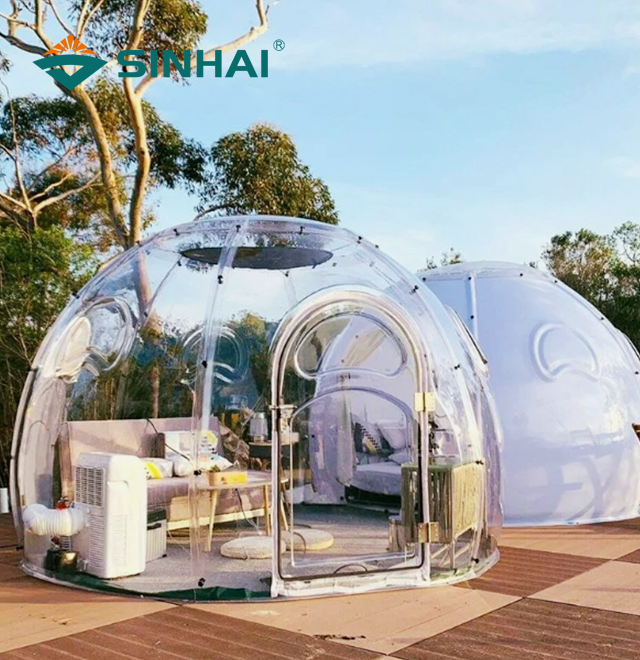
Polycarbonate Dome Sheet for Skylights & Curved Roofs
Over 25+ specialised lines and more than 60,000 tonnes of polycarbonate dome sheet are made by Baoding Sinhai Sunboard Manufacturing Co., Ltd. every year. The company has three production bases. Two 50µm layers of 100% new Bayer or Sabic PC resin are put on either side of each sheet. These layers block 98% to 100% of UV light below 380nm. You can get the sheet in widths up to 2.5m and sizes between 4mm and 25mm. It's meant to last a lifetime and lets between 60% and 82% of light through.
What Is a Polycarbonate Dome Sheet?
A polycarbonate dome sheet made from optical-grade polycarbonate resin is a curved or thermoformable part of architectural glass. The dome form makes the structure stiffer than flat sheets. It also lets water flow naturally, which reduces the amount of water that stays in the sheet and the stress that builds up over time.
As an alternative to glass and plastic, it is often used for roofs and awnings that need to hold weight. Glass is light and easy to break, but plastic can get surface cracks from being hit over and over. A normal test shows that 850 J/m of contact is enough to break glass. Computer dome sheets are much lighter, can handle 250–300 times that amount of force, and don't turn yellow when exposed to UV light because they have a co-extruded UV layer instead of a surface covering.
The dome shape can be made in three different ways: by vacuum forming, pressure forming, or cold-bending.
Key Technical Specifications
| Parameter |
Value |
| Thickness |
4–25mm (hollow 6–16mm / solid 3–12mm) |
| Effective Width |
Max 2.5m |
| Length |
Cut to order |
| Resin |
100% virgin Bayer / Sabic polycarbonate |
| UV Co-extrusion Layer |
50μm, both sides |
| UV Blocking Rate |
98%–100% (below 380nm) |
| Light Transmission |
60%–82% (standard); 0%–90% across full color range |
| Impact Strength |
850 J/m (250–300× glass) |
| Service Temperature |
-40°C to +120°C |
| Fire Rating |
B1 (GB 8624) / UL94 V-2, self-extinguishing |
| Warranty |
10–20 years |
| Certifications |
ISO 9001 / SGS / CE / RoHS |
| Packaging |
PE protective film + wooden pallet or crate |
Internal Structure Options
On the inside, there are two main structures that can be used to meet different load and span needs.
It has parallel air chambers that keep heat from moving through the structure's many walls. This makes it perfect for skylight domes and greenhouse canopies that need to keep heat in during the design process.
The load is spread out more evenly across the sheet plane when the structure is honeycomb or X-shaped. This lessens bending in the middle of wide or long spans, which is useful for big dome roofs and round shelters.
Both types of structures come in 4–25 mm widths and can be used with steel, metal, or wood frame structures.
Typical Applications
Industrial skylight systems—Domes that are used in factories and warehouses let natural light in. It's built to stand up to a lot of snow and strong winds. The sheet is not as likely to break when it hits something as glass pieces.
Dome tops and round buildings—Geodesic domes, eco-resorts, and high-end buildings all benefit from clear views from a wide angle. The co-extruded UV layer is meant to keep its look in deserts and seaside areas with a lot of sunlight.
In dome pergolas and building light wells, the sheet is used to spread out sunshine that keeps the inside bright. It can also be used in halls and covered paths.
The B1 and UL94 V-2 versions can be used in public places where fire safety is required by law, like subway entrances and public canopies.
Quality Inspection
For the polycarbonate dome sheet, when the raw materials are brought in, during processing, and again when the batch is sent out, they are all inspected in an organised way.
Key steps in the inspection process include checking the width of the UV layer (at least 50μm) to make sure the UV protection is complete, trying the material's ability to absorb energy with falling darts, and measuring the Yellowing Index (YI) to keep an eye on its long-term optical stability. Using ultrasonic gauges, the thickness uniformity across the dome's apex and flange zones is checked. Checks for optical distortion are done in situations where seeing clearly is important.
The ISO 9001:2015, CE, RoHS, and SGS standards are used to test and certify the products.
Customization and Technical Support
Shape and size of sheets are cut to fit the needs of the project. Cutting can be done with a CNC, special-shaped profiles, or thermoforming for solid PC types. Some common ways to make things are cold bending, vacuum forming, and pressure forming.
The technical information that comes with orders includes waterproofing details, screw layout plans, node design drawings, and expansion-gap specifications. These are made to support connections that don't leak or condense and are designed to fit dome assemblies.
OEM and ODM production are both possible. Buyers should check wait times directly with suppliers based on the size and details of their orders.
FAQ
Q1: What choices are there for thickness and width, and what kinds of structure frames work with them?
A: It can be anywhere from 4mm to 25mm thick. Your choice of length is cut to fit your needs, with a maximum effective width of 2.5m. The sheet works with frames made of steel, aluminium, and wood. With your order, you will get node drawings.
Q2: Is there technical support for installation?
A: Yes, there are. They include node design models, sealing details, screw placement plans, and expansion-gap specs. Video and internet coaching can be set up, and the availability of on-site help should be checked at the time of request.
Q3: What kinds of projects do you really use this sheet for?
A: It is often used for dome windows, dome roofs, circular buildings, light wells, dome pergolas, and covered walks. These are projects that need to be able to be thermoformed, let a lot of light through, and not crack when they are curved a lot.
Q4: What effect does thermal expansion have on the design of an installation?
A: The linear expansion coefficient for polycarbonate is 0.065 mm/m°C. For installation, the fixing holes should be too big and there should be EPDM seals to let the parts move without putting too much stress on them.
Q5: Will the sheet turn yellow after being outside for a while?
A: The 50µm UV co-extrusion layer on both sides is made to stop 98% to 100% of UV light below 380nm. The sheet has a warranty that covers significant yellowing for 10 to 20 years under normal outdoor conditions.
Q6: What is the best way to clean the sheet on the outside?
A: A soft microfibre cloth, light soap, and warm water should be used. Cleaners with ammonia and rough tools should be avoided because they can damage the UV co-extrusion layer.
Contact Us
Do you have more questions about polycarbonate dome sheet? Send your project requirements to [email protected].