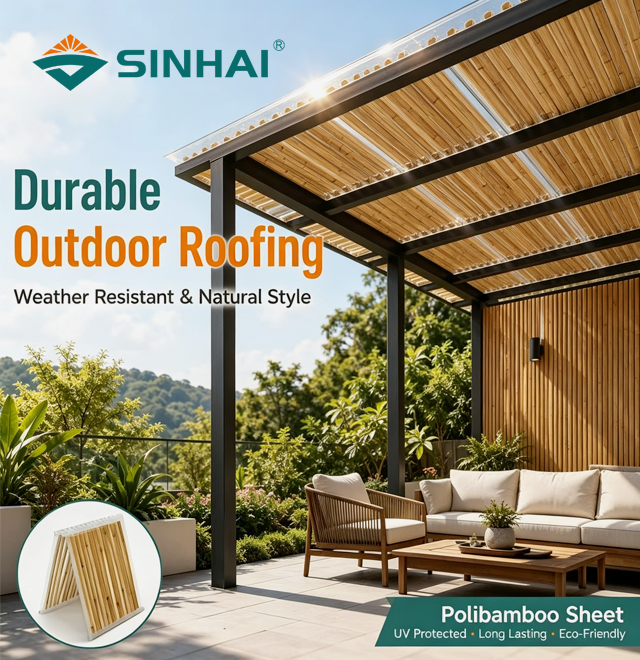
Polycarbonate Skylight Panel for Roof & Atrium — Natural Light, 10–20 Year Warranty
With more than 25 lines and an annual output of more than 60,000 tonnes, Baoding Sinhai Sunboard Manufacturing Co., Ltd. produces polycarbonate skylight panels across three production bases. Every panel is made from 100% new Bayer or Sabic PC resin and has a 50μm co-extruded UV layer that lets 60% to 85% of light through but blocks 98% to 100% of UV rays. These panels come with an ISO 9001, CE, and RoHS approval and a 10–20 year protection. They are available in thicknesses between 4 and 25 mm and widths of up to 2.5 m.
What Is a Polycarbonate Skylight Panel?
A polycarbonate skylight panel is a thermoplastic glass element made to let natural light into buildings while also being resistant to weather, UV rays, and contact stress.
It is about 50% lighter than regular glass and can be cold-curved into shapes that flat glass can't. It takes away the safety risk of breaking easily and lowers the need for artificial lighting by letting more natural light in.
With its optical clarity and long-lasting structure, it's a good choice for a wide range of industrial, commercial, and agricultural projects for roof and atrium glazing.
Key Technical Specifications
| Parameter |
Value |
| Product Form |
Full sheet, cut to project size |
| Thickness |
4–25mm (hollow: 6–16mm / solid: 3–12mm) |
| Effective Width |
Max 2.5m (full sheet, no overlap required) |
| Length |
Cut to order |
| Resin |
100% virgin Bayer/Sabic polycarbonate |
| UV Co-extrusion Layer |
50μm (blocks UV below 380nm) |
| Anti-UV Rate |
98%–100% |
| Light Transmission |
0%–90% (varies by color and surface); typical 60%–85% |
| Impact Strength |
850 J/m |
| Service Temperature |
-40°C to +120°C |
| Fire Rating |
B1 (GB 8624) / UL94 V-2, self-extinguishing |
| Warranty |
10–20 years |
| Certifications |
ISO 9001 / SGS / CE / RoHS |
| Packing |
PE protective film + wooden pallet or crate |
Core Product Advantages
Structural strength and safety
With an impact strength of 850 J/m, these walls are much stronger than glass when it comes to hail and accidents. The B1 fire grade under GB 8624 confirms that the material will put out its own fire; the flames do not spread across the surface.
Performance in terms of heat and light
The 50μm UV co-extrusion layer blocks 98%–100% of dangerous radiation and lets 60%–85% of light through. This protects internal items from fading caused by UV light. The material itself doesn't yellow over its whole useful life, so it doesn't need to be replaced.
Stability in temperature
A service range of -40°C to +120°C ensures steady performance in harsh settings, from cold winters in the north to hot factories.
Keeping out the weather and stopping condensation
Professional node design helps with installation by providing sealed joints, H/U profiles, and dust-proof tapes for dry glazing. This is especially important in farming gardens and indoor atriums, where too much water can hurt crops or equipment.
Full sheet supply—no need to cross
Polycarbonate skylight panels come in full sheets that are up to 2.5 m wide and can be cut to any length needed for the job. This means that there are no weak spots or possible leak paths in large-span roofs where sheets meet.
Application Scenarios
Industrial and Logistics Warehouses
Skylight panels made of PC can spread natural light evenly across large metal roofs. Specialised surface finishes help control the gain of solar heat, which lowers the summer cooling load.
Atria and tall buildings for business
The ability to cold-curve glass lets architects make shapes that flat glass can't. These panels can handle a lot of wind and snow, which makes them good for tough urban jobs.
Greenhouses for farming
The panels let in only the wavelengths of light that plants need to grow and can withstand heavy hail damage. A surface that doesn't let water droplets stick to it keeps them from falling on crops or equipment below.
Using Other Tools
Some places where natural light, weather protection, and long life are all needed at the same time are pergola roofs, carports, light wells, stadium roofs, swimming pool covers, hallways, and industrial daylighting systems.
Quality Control Process
When making something, there are three steps of inspection: getting the raw materials, making the result, and doing one last check before shipping.
What are the most important things that are looked at? The impact resistance (ISO 6603 falling dart test), the light transmission and haze (ASTM D1003), the yellowing index to check long-term optical stability, and the UV layer thickness that needs to be at least 50μm.
Accelerated ageing tests (QUV) are like being out in the sun for a long time. To make sure the structure is the same, an ultrasonic scale checks the sheet's thickness all over to make sure it is the same.
People who buy something get guarantee certificates, information on UV layers, and fire rating test results with every package.
Customization and Supply
Sinhai offers OEM and ODM services for projects that need something in a certain size, colour, or surface. CNC cutting, film coating, bending, special-shaped cutting, vacuum forming, and thermoforming are all ways that solid PC sheets can be processed.
With more than 70 corrugation moulds and the ability to cut sheets to any length, most project needs can be met without having to buy new tools. Most standard orders are finished in seven days or less. You can get free samples, and the wait time for samples is 7–15 days.
For markets in Central Asia, the Kashgar production base allows for delivery within the region in about 7 days. There are local warehouses in Tashkent and Dushanbe that give suppliers more options. Shipping by sea, truck, or air is all possible.
Installation and Structural Compatibility
These panels can be used with frames made of steel, metal, or wood. For each job, Sinhai gives sealing information, screw placement plans, node models, and expansion-gap specs.
Metal and polycarbonate both have the same heat growth rate. The technical paperwork says that the connecting holes must be too big and that EPDM seals must be used so that the product can move without cracking.
For regular sales, you can get video and online installation help. For large orders, you can get technical help right where you are.
FAQ
Q1: What sheet sizes and designs work with each other?
A: It comes in thicknesses between 4 and 25 mm, has a maximum width of 2.5 m, and is cut to the length needed for the job. Steel, aluminium, and wood frames can all work with panels. With every order, you'll get full node drawings.
Q2: Is there technical support for installation?
A: The product comes with free node design, sealing details, screw layout drawings, and expansion-gap plans. For all sales, you can get video and online help. For large jobs, you can get support at the site.
Q3: What are some common uses for skylights?
A: Light wells, flat roofs, pergolas, carports, atriums with skylights, and stadium roofs. Key performance factors include resistance to hail, control of condensation, and wind load capacity.
Q4: How does the panel deal with temperature changes?
A: When it gets hot, polycarbonate stretches more than metal. For installation to work, the fixing holes must be too big and the EPDM gaskets must be flexible so that the seal doesn't crack. The right growth gap specs are shown on all the technical models that are sent.
Q5: How should I clean these panels?
A: Only use neutral soap and clean water. Cleaning products that are rough, alkaline, or based on solvents can hurt the co-extruded UV layer and shorten its usefulness.
Q6: What can be done to stop condensation from forming on the inside surface?
A: Ask for panels that have a treatment on the inside that stops drips or fog. This makes the surface less stiff, which stops water drops from forming and falling to the floor, plants, or equipment below.
Contact Us
Do you have more questions about polycarbonate skylight panel? Request specifications, free samples, or a project quote — email us at [email protected] and our team will respond promptly.