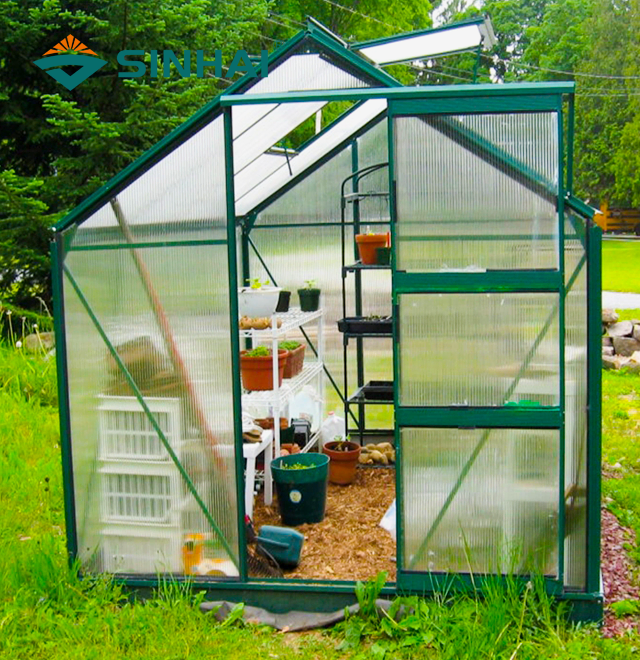
Polycarbonate Greenhouse Sheet for Commercial and Agricultural Glazing
Baoding Sinhai Sunboard Manufacturing Co., Ltd.'s polycarbonate greenhouse sheet is produced on three production bases with 25+ lines annually. Sheets are made from 100% virgin Bayer or Sabic PC resin and have a 50μm UV layer that inhibits UV below 380nm. The impact strength is 850 J/m, and light transmission is 88%. All panels have 10–20-year warranties.
What Growers Actually Need from a Glazing Panel
Poor thermal insulation that raises heating costs, UV deterioration that leaves panels brittle and opaque in a few years, and hail or object damage cause most greenhouse glazing failures. Polycarbonate greenhouse sheets meet all three if its resin quality, UV protection technique, and structural profile fit your environment and crop needs.
Twin-wall, multi-wall, and solid sheets are offered. On most commercial greenhouse roofs, 6–10mm twin-wall panels work. Lower-cost or temporary buildings use corrugated alternatives (0.75–3.0mm). Every setup emits PAR to maintain crop growth.
Key Technical Specifications
| Parameter |
Value |
| Thickness |
4–25mm (twin-wall, solid, corrugated) |
| Effective Width |
Max 2.5m (full sheet, no overlap) |
| Length |
Cut to order |
| Resin |
100% virgin Bayer/Sabic polycarbonate |
| UV Co-extrusion Layer |
50μm, blocks UV below 380nm |
| Anti-UV Rate |
98%–100% |
| Light Transmission |
80%–88% (greenhouse grades); 0%–90% by color and finish |
| Impact Strength |
850 J/m (250–300× stronger than standard glass) |
| Service Temperature |
–40°C to +120°C |
| Fire Rating |
B1 (GB 8624) / UL94 V-2, self-extinguishing |
| Warranty |
10–20 years |
| Certifications |
ISO 9001:2015, CE, RoHS, SGS |
| Packing |
PE protective film + wooden pallet or crate |
Performance Characteristics
Balance of light and heat. Light that passes through at a rate of 80% to 88% supports active photosynthesis. When compared to single-layer glazing, the twin-wall air-channel structure provides better thermal insulation. This is important for businesses that are open during cold weather.
Resistance to impact. With a strength of 850 J/m, panels can withstand hail, falling trees, and other impacts without breaking. This is 250 to 300 times stronger than regular garden glass. This is important in places with a lot of wind or snow, where replacing glass is a regular cost.
Method for blocking UV rays. The 50εm UV layer is co-extruded during production and sticks to the panel surface forever. It's not a surface coat or a coating that was added after the fact. It stops UV light below 380nm and helps the panel stay optically stable over time.
Anti-drip protection is not required. A layer on the inside that attracts water lowers the surface tension, which makes condensation spread out into a thin film instead of drops. Water runs to ditches instead of landing on plants. This makes it less likely that veggie, flower, and young crops will get fungus.
Stable temperature. From -40°C to +120°C, the sheet doesn't change shape. The rate of thermal growth is about 0.065 mm/m°C. The expected 3mm/m of movement across temperature changes is made possible by oversize holes that were pre-drilled and EPDM gaskets that were used during installation.
Greenhouse Applications
This polycarbonate greenhouse sheet is used for many different types of projects by commercial farmers, research institutions, and agri-tourism businesses.
- Industrial Venlo greenhouses are used to grow a lot of vegetables, so they need to be able to keep the right temperature and stand up to snow and wind loads. It is best to use 4–16 mm twin-wall panels.
- Botanical gardens and research centers: light-diffusing panels stop hotspots and make sure that PAR is evenly distributed across all leaf layers, which helps breed valuable crops.
- Eco-restaurants and agritourism buildings need attractive glass that is safe for public areas, hard to break by accident, and easy to keep up.
- Retail garden centers need long-lasting, clear roofs that keep customers and goods safe without the need for heavy frames.
- Seedling and flower greenhouses with high-transmission screens that don't drip and keep the temperature inside fixed from planting to harvest.
Customization and Supply Options
There are clear, opal, blue, green, and bronze panels that range in thickness from 4 mm to 25 mm. It can be up to 2.5m wide and doesn't need any lap joints. The length is cut to fit your project.
As part of OEM and ODM services, solid PC panels can be CNC cut, film coated, bent, cut into shapes, and thermoformed. For corrugated profiles, there are more than 70 moulds that can be used at no extra cost. Full node drawings, screw layout plans, and waterproofing details are sent with every order of structural frames made of steel, aluminium, or wood.
Orders for regular production are usually finished in about a week. Central Asian buyers can get their orders delivered within about 7 days through the Kashgar production base. For faster delivery in Tashkent and Dushanbe, there are local warehouses that can be used.
Quality and Standards
Every batch is checked three times: when the raw materials are received, when the product is being made, and before it is shipped. Make sure the cover is resistant to contact, light transmission, flame retardancy, and ageing.
When the Chinese National Standard for Plastics—Polycarbonate Sheets came out on September 29, 2024, and went into effect on April 1, 2025, Baoding Sinhai Sunboard Manufacturing Co., Ltd. was one of the main groups that worked on it. These items are certified by ISO 9001:2015, CE, RoHS, and SGS.
FAQ
Q1: What thickness and structure are available?
A: Solid, twin-wall, and corrugated profiles are 4mm–25mm thick. Maximum width 2.5m, length custom cut. Complete node drawings are sent with orders for steel, aluminium, and wood frames.
Q2: Is installation support included?
A: Yes, free node design, waterproofing, screw arrangement, and expansion-gap recommendations are offered. Videos and remote help are available. For big orders, on-site help is available.
Q3: Which panel faces the sun?
A: Face the UV-protected side out. Marked on PE film. Inverse panel installation exposes the uncovered surface to UV, producing brittleness and light transmission loss.
Q4: In actuality, how does anti-drip coating work?
A: Because of the hydrophilic coating on the inside, condensation forms a thin film instead of droplets. Reduces fungal infection and foliage damage by channelling moisture to gutters.
Q5: How should installation thermal expansion be managed?
A: At 0.065mm/m°C, polycarbonate expands. Oversize pre-drilled holes and EPDM gaskets enable 3mm/m mobility. Prevents panel buckling and frame tension during seasonal temperature variations.
Contact Us
Do you have more questions about polycarbonate greenhouse sheet? Send project requirements, drawing requests, or sample inquiries to [email protected].