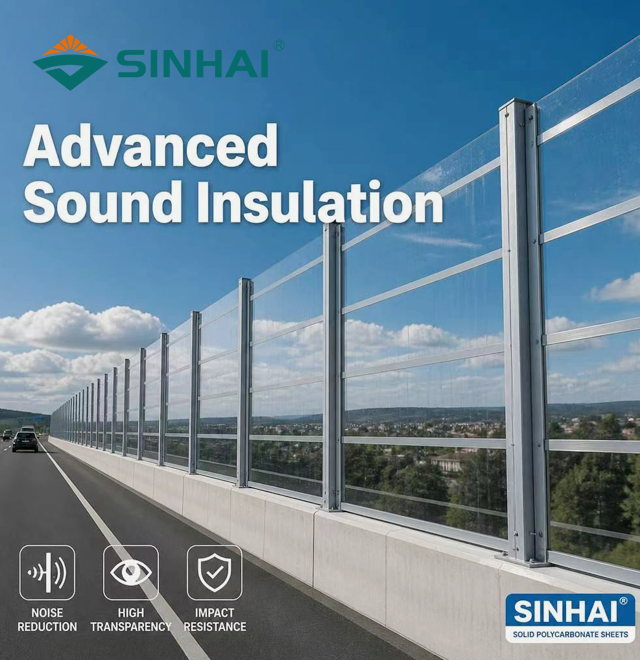
Sound Insulation Polycarbonate Sheet for Noise Barriers, Industrial Enclosures & Architectural Glazing
Sound insulation polycarbonate sheet from Baoding Sinhai Sunboard Manufacturing Co., Ltd. is a type of acoustic glass that is made for projects that need to block out noise and let in natural light. These sheets are made on three factories with more than 60,000 tonnes of dedicated lines and 20–30 dB less noise than glass. They are also about half the weight of glass. The thicknesses range from 4 to 25 mm, and the light transmission is between 60% and 80%. Each shipment comes with a warranty certificate that covers 10 to 20 years, depending on the specifications.
What Is a Sound Insulation Polycarbonate Sheet?
High-density casting was used to make this fibreglass building piece. Its honeycomb or multi-wall core makes air pockets that are blocked off and bounce and absorb sound waves across a wide frequency range. This makes it an acoustic shield that is built into a single clear panel.
Compared to laminated glass, it makes the structure much lighter. Unlike plastic, it doesn't break when hit. And unlike polycarbonate that hasn't been treated, the co-extruded UV layer on these sheets stops the tiny cracks that usually happen with acoustic seals over time.
Because of these qualities, it can be used as a noise barrier, in industrial enclosures, and for commercial glazing where both durability and daylight need to be kept.
Technical Specifications
| Parameter |
Value |
| Product Form |
Twinwall / Triple-wall / Four-wall / Honeycomb / X-structure |
| Thickness |
4–25 mm (common: 4 / 6 / 8 / 10 / 12 / 16 / 20 / 25 mm) |
| Effective Width |
2,100 mm standard; 1,050 mm and 1,220 mm also available |
| Length |
Cut to order |
| Resin |
100% virgin Bayer / Sabic polycarbonate |
| UV Co-extrusion Layer |
50 µm (blocks UV below 380 nm) |
| Anti-UV Rate |
98%–100% |
| Light Transmission |
0%–90% (varies by color and surface) |
| Impact Strength |
850 J/m |
| Service Temperature |
−40°C to +120°C |
| Sound Reduction |
20–30 dB (sealed air chambers) |
| STC Rating |
25–38 dB depending on thickness |
| U-value |
Down to 1.6 W/m²K (multiwall) |
| Fire Rating |
B1 (GB 8624) / UL94 V-2 |
| Density |
~1.2 g/cm³ |
| Warranty |
10–20 years |
| Certifications |
ISO 9001:2015 / CE / RoHS / SGS / UDEM |
| Packing |
PE protective film + wooden pallet or crate |
Performance Characteristics
Acoustic attenuation across thicknesses.
In most installations, the sealed air chambers inside the multi-wall core cut sound transmission by 20 to 30 dB. Depending on the thickness of the panel, STC ratings range from 25 to 38 dB, which provides good sound separation while keeping the view clear. This weight profile—about 1.2 g/cm³ compared to about 2.5 g/cm³ for glass—lowers the load that support structures need to carry in uses like highway dividers and elevated rail.
It can handle impacts well enough for use in infrastructure.
Because they have an impact strength of 850 J/m, these panels don't break when hit by wind-driven debris, train pressure waves, or industrial shock loads. Acrylic panels, on the other hand, would. This is important in situations where replacing the barrier while it's loaded is not possible.
Performance that stays the same at all temperatures.
The service range of -40°C to +120°C includes cold buildings, hot industrial roofs, and outdoor sites in cities. The panels don't bend or change size, which could make the sound seals at the panel joints less effective.
UV protection that keeps the sound quality for a long time.
It stops 98% to 100% of UV light below 380 nm. The 50 µm co-extruded UV layer does this. This stops the yellowing, weakening, and micro-cracking that can happen over time and leave sound gaps at the edges of panels and fixing points. This is the main way that outdoor sound barriers break down over time.
Controlling temperature while letting light through.
Between 60% and 80% of light passing through means that rooms inside can be used during the day without artificial lighting. When you use multiple walls, the U-value drops to 1.6 W/m²K, which makes climate-controlled enclosures less thermally demanding. The B1 fire grade under GB 8624 and the UL94 V-2 classification allow it to be used in public and business buildings.
Typical Applications
Highway and rail noise barriers.
On many infrastructure projects, clear barriers are needed to keep drivers' lines of sight open and prevent visual obstruction. While meeting transparency requirements that opaque concrete panels cannot, sound insulation polycarbonate sheet can handle wind loads and flying debris.
Machine enclosures for industry.
Transparent PC partitions around heavy equipment let operators see what's going on with the equipment, and the enclosure lowers the noise level to meet noise regulations at work. The pieces can be cut, shaped, and changed without the help of professionals who work with glass.
Glass for buildings and businesses.
Office dividers, walls in airport terminals, gym dividers, and soundproofing in high-rise apartments in cities all need to be able to separate sounds and let light through. Panels with widths ranging from 6 mm to 16 mm can be used for a wide range of things, from business walls inside to load-bearing glass outside.
Customization and Supply
Baoding Sinhai works on both OEM and ODM projects. Some of the things they do are CNC cutting, film finishing, cold bending, special-shaped cutting, vacuum forming, and thermoforming. A standard panel width is 2,100 mm, but they can also be made in widths of 1,050 mm and 1,220 mm. The length is cut to your needs.
Most orders are sent out within 7 days. For Central Asian markets, the Kashgar production base sends goods by truck to countries where they are going in about 7 days. Regional fulfilment is helped by having warehouse stock in Tashkent and Dushanbe. You can send goods by sea, truck or aeroplane, and the logistics team will take care of clearing customs and getting you the right paperwork for crossing borders.
You can get free samples. The wait time for sampling is 7–15 days.
Quality Control and Certifications
Sound insulation polycarbonate sheet undergoes three stages of inspections that happen during production: when the raw materials are brought in, while the product is being made, and when it is delivered. Some of the signs that are watched are resistance to contact, resistance to light transmission, resistance to flame, and resistance to weathering.
Certifications up to now: CE, RoHS, SGS, UDEM, ISO 9001:2015.
The Chinese National Standard for Plastics—Polycarbonate Sheets, which came out on September 29, 2024, and went into effect April 1, 2025, was mostly written by Baoding Sinhai. With every shipment comes a warranty certificate that is good for 10 to 20 years, depending on the specification that was ordered.
FAQ
Q1: What structures and thicknesses are available?
A: Twinwall, triple-wall, four-wall, honeycomb, and X-structure configurations are all produced. Standard thicknesses are 4, 6, 8, 10, 12, 16, 20, and 25 mm. Width options are 2,100 mm, 1,050 mm, and 1,220 mm. Length is cut to order.
Q2: How does thermal insulation compare to glass?
A: Twinwall panels deliver a U-value of approximately 3.3 W/m²K. Multiwall configurations reduce this to 1.6 W/m²K, which is meaningfully lower than standard single-pane glass. This affects energy load calculations for climate-controlled facilities.
Q3: Does greater thickness give proportionally better noise reduction?
A: Not in a linear way. Greater thickness improves insulation at lower frequencies, but the weighted sound reduction index (Rw — the single-number rating used to compare acoustic performance across products) is also affected by the internal cell structure and installation method. Gasket and sealant selection at fixing points influences the installed result as much as panel thickness does.
Q4: Can the sheet be cold-curved on site?
A: Yes. Cold bending to a minimum radius of approximately 175 times the sheet thickness is supported. Curved installations can also help diffuse reflected sound in certain architectural configurations.
Q5: How does UV exposure affect acoustic performance over time?
A: The co-extruded 50 µm UV layer blocks 98%–100% of UV below 380 nm. Without this layer, UV degradation would cause surface embrittlement and micro-cracking at panel edges — creating acoustic leakage paths that reduce insulation performance over time. The co-extrusion prevents this across the warranty period.
Q6: What installation details matter most for noise reduction?
A: EPDM gaskets and acoustic-grade sealants at all fixing points are essential. Sound flanking — where airborne noise bypasses the panel through gaps at edges or fasteners — is the most common cause of underperformance in installed barriers. Panel selection and installation detailing both contribute to the final result. Contact us for project-specific guidance.
Contact Us
Do you have more questions about sound insulation polycarbonate sheet? For specifications, samples, or a project quote, email [email protected].