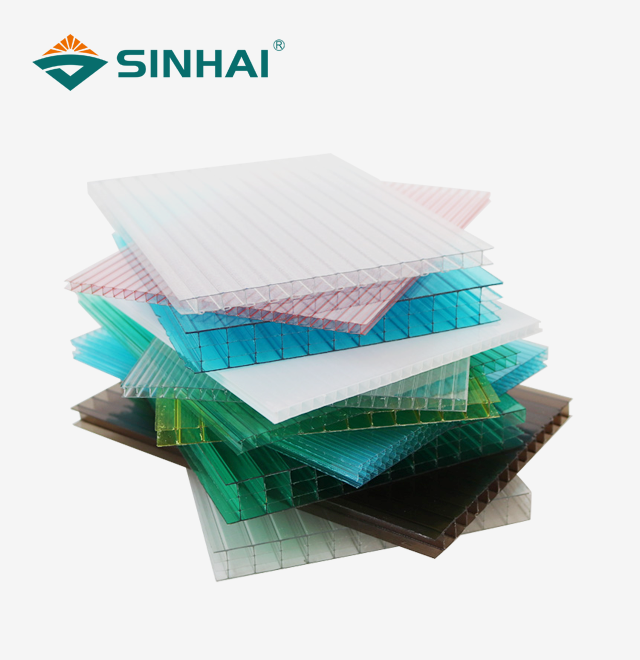
Hollow PC Sheet for Roofing, Greenhouse & Glazing — Lightweight, UV-Protected, Long-Lasting
Hollow PC sheet, often known as multiwall polycarbonate, is a thermoplastic panel with internal ribs and air chambers that increase thermal insulation while reducing weight. Produced by Baoding Sinhai Sunboard Manufacturing Co., Ltd with over 25 production lines, we have 3 manufacturing bases of these panels. Standard thickness is from 3mm to 12mm, light transmission is from 60% to 82%, operating range is from -40°C to +120°C. Each sheet is 100% virgin resin or high SABIC/BAYER material with co-extruded UV on one or both sides.
What Is a Hollow PC Sheet?
A hollow PC sheet is a multiwall polycarbonate panel, created by a co-extrusion method. Its interior air chambers are bounded by parallel walls, offering the panel thermal insulation, structural stability, and low weight in a single profile.
It is about 200-250 times more impact resistant (ISO 179 Charpy) than glass. It's around 30 times harder than acrylic. Because of these features, it is a feasible option anywhere glass is too heavy, too brittle, or too expensive to install in scale.
The material may be cold-curved on site as well. The minimum bending radius is 175 times the sheet thickness, which means that you can make curved roofs and arched canopies without having to cut or heat the panel.
Key Technical Specifications
| Parameter |
Details |
| Thickness |
3mm – 12mm |
| Edge Shape |
Rectangular edge / Circular edge |
| Light Transmission |
60% – 82% |
| Temperature Range |
-40°C to +120°C |
| UV Protection Layer |
50 – 109 microns, co-extruded (1 or 2 faces) |
| UV Blocking Rate |
99% of harmful UV rays |
| Impact Resistance |
~200–250× greater than glass (ISO 179 Charpy) |
| Thermal Conductivity (U-value) |
1.1 – 3.9 W/m²K (varies by wall structure) |
| Yellowing Index (ΔYI) |
< 5 over 10 years (ASTM D1925) |
| Fire Rating |
B1 flame retardant, self-extinguishing (EN 13501-1) |
| Colors |
Transparent, lake blue, bronze, grey, green, orange, amber, opal, silver, yellow, dark blue, or custom |
| Raw Material |
100% virgin resin, SABIC, BAYER, or customized |
| MOQ |
500 m² |
| Free Sample |
Supported |
| Certifications |
ISO 9001:2015, CE, RoHS, UDEM |
Product Characteristics
The 3–12mm range of thickness serves a broad spectrum of structural demands, from tiny garden pergolas to huge industrial roofing systems. Choosing the proper thickness relies on estimated load, purlin spacing, and local wind or snow conditions.
Light Transmission Light transmission of 60% to 82% permits a bright interior without direct glare. The cellular wall construction also diffuses incoming light, which is especially helpful in greenhouse growth areas and public corridors where direct sunshine would generate hot spots.
The co-extruded UV layer (50 to 109 microns, on one or both sides) is an essential element of the panel surface and is produced during the manufacturing process. This is not a post production coating. This layer prevents 99% of dangerous UV radiation and maintains the yellowing index below ΔYI 5 during a ten-year period, as tested per ASTM D1925. Yellowing and loss of light transmission are covered by a 10-year guarantee.
Panels rated from -40°C to +120°C are dimensionally stable in cold winter & summer roof heat. Most installation climates are within this range without additional treatment.
The sheeting is resistant to numerous organic and inorganic acids. For normal cleaning neutral detergents are suggested. The fire rating B1 according to EN 13501-1 describes the material as flame retardant and self-extinguishing, suitable for public buildings, transport infrastructure and industrial facilities where fire compliance is necessary.
Main Application Areas
Polycarbonate is used in greenhouses and agricultural constructions where both light dispersion and temperature retention are desired. The air chambers avoid heat loss at nite and aid to stabilise rising temperatures in cold and warm climes.
This panel’s resilience to severe wind loads and exposure to chemical vapours makes it ideal for industrial roofing and skylights. Daylighting solutions in factories and warehouses decrease dependency on artificial light and provide safe working conditions.
Popular for canopies, pergolas and awnings are 6mm and 8mm panels. Its cold-curving ability allows field installers to create arched profiles without the need for heating equipment or specific gear.
Hollow PC sheet is used in highway and rail sound barriers for acoustic insulation and debris resistance. The material maintains its structure during constant vibration and extensive UV exposure.
Other uses include curtain walls, dividers, swimming pool enclosures and advertising light boxes especially when it is necessary to have a panel that is both transparent and impact resistant.
Customization and Supply Options
OEM and ODM manufacture are supported. Processing options available include CNC cutting, custom film coatings, bending, special-shaped cutting, vacuum shaping and thermoforming for solid PC sheets. For colour requests beyond regular range, we may talk on your project need.
3 manufacturing bases and 25+ production lines for high-volume orders to ensure batch-to-batch quality consistency. Usually, regular orders are processed in around 7 days after the confirmation of the order.
The Kashgar manufacturing base will cut the transportation time to around 7 days for projects in Central Asia. Local warehouse resources in Tashkent and Dushanbe allow regional customers to get speedier fulfilment. Shipments are set up via sea, truck or air depending on destination and urgency.
Installation Points to Keep in Mind
The lifespan of the panels is closely related to proper installation.
- UV side orientation: The side with the printed protective film should be toward the sun. The unprotected face is exposed to UV light when the sheet is turned over, which reduces the service life.
- Seal the channels: Anti dust vented tape on the lower edge and solid tape on the upper edge, U-profiles on both ends. This lets the condensation out, but keeps the hollow chambers free of dust and insects.
- Walking on panels: Do not walk directly on sheets during installation. Distribute the weight using crawling boards over at least three purlins. Good for diffused impact, but could shatter under concentrated point pressures.
- Roofing thickness 4mm panels Suitable for modest DIY projects and light-weight construction of a greenhouse. If you have wind or snow load on the roof, 6 or 8mm is the practical minimum to avoid deformation, and separation of the structure.
- Cleaning: Use only neutral detergents. Highly alkaline cleansers and solvents will harm surface and impact effectiveness of the UV layer.
FAQ
Q1: If I leave the sheet outside for a few years, will it turn yellow or break?
A: In answer to your question, the co-extruded UV layer (50–109 microns) stops 99% of UV rays that are bad for the resin below. The warranty lasts for 10 years and covers yellowing and loss of light transmission.
Q2: How should the installation be done? Which side should face the sun?
A: The side that has the printing protective film on it must face the sun to get UV protection. The panel will last much less long if you install it backward.
Q3: What can I do to keep dust and water out of the open chambers?
A: Put anti-dust tape with holes in the bottom edge and solid closing tape on top. Then, cover both ends with U-profiles. This set-up lets the condensation drain while keeping bugs and dust out.
Q4: Can a roof be made of a 4mm panel?
A: 4mm is usually enough for small do-it-yourself projects or light garden buildings. For roofs that get wind or snow, 6mm or 8mm is the bare minimum to keep the sheet from bending and keep it in place in the frame.
Q5: Can I walk on the sheets while they are being put up?
A: Try not to step right on the panels. Lay at least three purlins across the top of the boards. Polycarbonate can take loads that are spread out well, but a concentrated point load, like the heel of a shoe, can break the panel.
Q6: Why do some sheets on the market turn yellow more quickly than others?
A: One common reason is using recycled or regrind material instead of 100% new resin, or the UV protection layer is too thin or not there at all. For consistent long-term performance, SINHAI sheets are made with 100% virgin resin or SABIC/BAYER material that has a UV layer that is co-extruded in the factory.
Contact Us
Have a project requirement or want to request a free sample? Reach us at [email protected]. We respond to technical and commercial inquiries for hollow PC sheet orders.