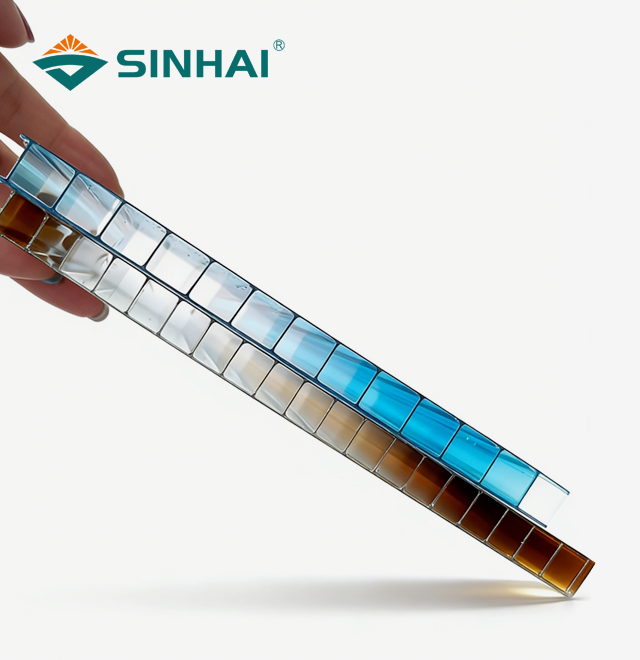
Twinwall Polycarbonate Sheet for Roofing & Glazing — Lightweight, High-Insulation, UV-Protected
Baoding Sinhai Sunboard Manufacturing Co., Ltd. manufactures Twinwall polycarbonate sheet, a two-layer extruded thermoplastic panel for roofing, glazing and daylighting applications. It is available in 3–12 mm thick and transmits 78% to 82% of light. A 50 µm co-extruded UV layer blocks 98% to 100% of the UV radiation. Sinhai has the certifications of ISO 9001:2015, CE, RoHS and UDEM. Each sheet is guarantyd for 10 years against yellowing or transparency loss.
What Is a Twinwall Polycarbonate Sheet?
Thermoplastic panels that have been made make up a twinwall polycarbonate sheet. It has two flat, parallel layers that are joined by long, internal ribs. Due to the air gap between the walls, the panel has a thermal U-value of 2.3–3.9 W/m²K, which is lower than single-glazed glass and higher than thermally efficient glass.
Glass and plastic don't have these three problems that happen in real life:
- The twin-wall air duct lowers the costs of heating and cooling, which is called thermal inefficiency.
- Lighter than glass, it can hold smaller buildings.
- Heavy loads, hail, and debris don't hurt it, and its impact strength is 250 times that of glass (ASTM D-3763).
The panel is structurally rigid without adding extra weight because the flutes are spaced 6 mm apart on the inside.
Key Technical Properties
| Property |
Value |
| Thickness Options |
3 mm, 4 mm, 6 mm, 8 mm, 10 mm, 12 mm |
| Wall Structure |
2-layer twin wall with 6 mm flutes |
| Light Transmission (Clear) |
78%–82% |
| UV Blocking Rate |
98%–100% |
| UV Layer Thickness |
50–109 microns (co-extruded) |
| UV Layer Sides |
1 or 2 faces available |
| Thermal U-Value |
2.3–3.9 W/m²K (varies by thickness) |
| Impact Strength |
250× that of glass (ASTM D-3763) |
| Operating Temperature |
−40°C to +120°C |
| Flame Rating |
Class A (ASTM E84) |
| Warranty |
10 years |
| Certifications |
ISO 9001:2015, CE, RoHS, UDEM |
Materials & Color Options
New, fresh polycarbonate plastic is used to make sheets. Plywood panels made from imported SABIC or Bayer (Covestro) resin are also available for projects that need to be able to show where the raw materials came from.
Choices of standard colours:
Transparent, Bronze, Grey, Opal, Lake Blue, Amber, Dark Blue, Silver, Orange, Yellow, and Custom
ODM and OEM services let you use custom colours and film finishes.
Applications
Commercial Greenhouses
The panel's ability to keep heat in and let 78% to 82% of light through helps keep growing temperatures stable. All year long, plants do well with light that is spread out.
Roofs and industrial facades
The panel allows natural light into warehouses, factories, and public buildings without adding weight to the structure. It also meets safety standards for wind load and seismic activity.
With patios, pergolas, and canopies just for you
Support bars can be smaller because this item is thin. Heavy hail or snow won't break the building because it has an ASTM D-37633 rating of 250 glass impact strength.
Curtain walls, screens, swimming pool covers, sound barriers, and advertising light boxes are some of the other things that they can be used for.
Quality Control
While receiving twinwall polycarbonate sheet raw materials, during production, and after the final delivery, Sinhai inspects them. Important checks include:
- layer thickness of 50 microns
- Simulation of hail conditions for impact resistance testing using the falling dart technique (ISO 6603)
- Yellowness Index (YI) Testing—as per ASTM D1925 standards
- Dimensional Tolerance Checks: These criteria are tested to ensure rib spacing and width tolerances work with H- and U-profiles.
Installation Guidance
- One portion of the UV light should be facing the sun. The printed safety film reveals the UV protected face. Installing it the wrong way shortens the life of the panel considerably.
- Seal the edges properly. Use anti-dust tape with vents cut in the bottom form to allow water to drain away while keeping out dust, pests and algae spores.
- Put on strong aluminium tape on the top.
- Never step on the panels directly. Lay movable boards over at least 3 purlins to spread the load and avoid point-load breakages.
- Low temperature radius of curvature: Minimum 150 to 175 times sheet thickness, depending on kind of resin employed.
Customization & Supply
Sinhai can manage both standard stock and project-specific needs:
- OEM/ODM services for private labels or specific requirements
- Solid PC applications with CNC (computer numerical control) cutting, bending, vacuum forming and thermoforming.
- All order sizes accepted.
- 3 Factories, about 25 manufacturing lines and 60,000+ tonnes each year
- Average wait time for orders is roughly 7 days.
- Delivery to Central Asia: eight days from the manufacturing base in Kashgar
- Regional users may access abroad shops in Tashkent and Dushanbe.
- Logistics: Delivery of products by boat, truck or aircraft and assistance with customs clearance
FAQ
Q: Are you wondering if the sheet will turn yellow or break after being in the sun for a long time?
A: Each panel has a 50-µm co-extruded UV layer that safeguards the inner plastic from breaking down by blocking 98% to 100% of UV rays. Sinhai offers a 10-year guarantee against yellowing and light failure.
Q: When installing, which side needs to be facing the sun?
A: Whichever side has the printed protective film (that shows the UV-protected side) must always face the sun. Switching the orientation will shorten the life of the panel.
Q: Why doesn't water or dust stay inside the hollow chambers?
A: To get rid of moisture while keeping out dust, bugs, and algae spores, use open anti-dust tape on the bottom profile. Complete the job by adding U-profiles and sealing the top with solid aluminium tape.
Q: Can a 4 mm sheet be used for roofing?
A: A 4 mm panel is good for small home projects and gardens that don't rely on heavy loads. Where there is a lot of wind or snow, 6 mm or 8 mm roofing material is usually the best choice. You can confirm the right thickness for your project by sending us the details of your work.
Q: During the installation, can I walk on the sheets?
A: Avoid walking on plastic plates directly. To spread the weight, put moving boards over at least three purlins. Regardless of the sheet's total impact grade, concentrated point loads can break it.
Q: What choices are there for raw materials?
A: A standard panel uses polycarbonate plastic that is 100% new. If you need project-specific material tracking, you can get imported SABIC or Bayer (Covestro) resin.
Contact Us
Do you have more questions about twinwall polycarbonate sheet? Send your project requirements or sample request to [email protected].