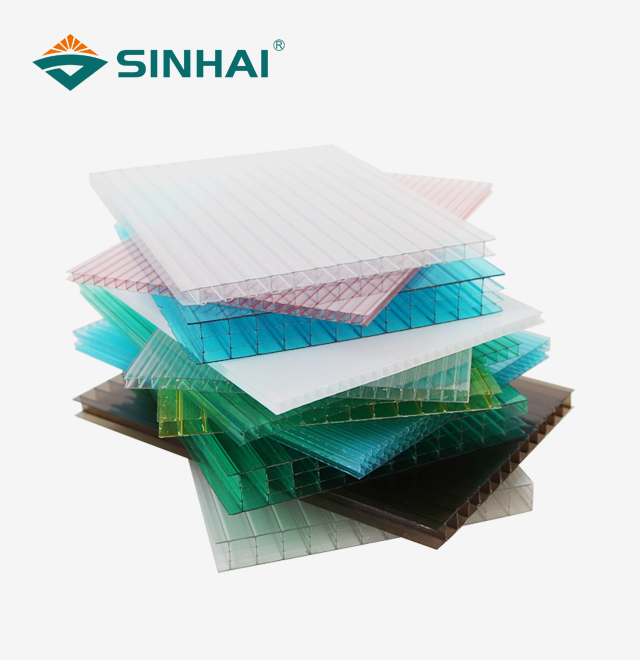
UV Coating Hollow PC Sheet — Anti-Yellowing Roofing & Glazing Panels
With a 50-m co-extruded UV-absorbent layer fused straight into the surface during extrusion, Baoding Sinhai Sunboard Manufacturing Co., Ltd. produces UV coating hollow PC sheet panels. This layer stops 98% to 100% of UVA and UVB rays below 380nm, which keeps the resin from turning brown when it's exposed to sunlight for a long time. The screens are certified by ISO 9001:2015, CE, and RoHS and come in widths ranging from 3 mm to 12 mm. They let through up to 82% of light. The company has three production sites with more than 25 production lines that make more than 60,000 tonnes of goods every year.
What Is a UV Coating Hollow PC Sheet?
A UV coating hollow PC sheet is a multi-wall polycarbonate glass panel made through a co-extrusion method that embeds a UV-absorbent layer right into the sheet surface rather than painting it on or laminating it after it is made.
Because the 50µm UV layer is sealed into the material during casting, it doesn't come off when you clean it or let it weather. Co-extruded UV protection is different from surface-applied products because it is structurally integrated.
The main purpose of this design is to stop photo-oxidation, which is what happens to regular polycarbonate when it is exposed to UV light for a long time and goes yellow and loses its ability to resist impact. By blocking out harmful UV radiation, the sheet stays stable in its shape and clear for years of use outside.
Key Technical Specifications
| Parameter |
Details |
| Thickness |
3mm – 12mm |
| UV Layer Thickness |
50μm (single or both sides; up to 109μm available) |
| UV Protection Rate |
98% – 100%, blocks UVA/UVB below 380nm |
| Light Transmission |
Up to 82% |
| Outdoor Service Life |
10 – 20 years (anti-yellowing) |
| Material |
100% virgin polycarbonate resin (SABIC / BAYER available) |
| Colors |
Transparent, Bronze, Grey, Opal, Lake Blue, Amber, Dark Blue, Silver, Orange, Yellow, or custom |
| Impact Strength |
~250× that of silicate glass; ~30× that of acrylic |
| Thermal Insulation |
U-value as low as 2.1 W/m²K (10mm thickness) |
| Weight |
~1/12 the weight of equivalent glass |
| Fire Rating |
B1 / Class A (self-extinguishing, no toxic gas) |
| Certifications |
ISO 9001:2015, CE, RoHS |
Performance Characteristics
Not likely to turn yellow over time. Without the co-extruded 50εm UV layer, polycarbonate sheets would break down by 20% or more after 10 years of being outside. But this layer keeps light loss to less than 6%.
3 to 12 millimetres thick. Architects and builders can use the same family of goods for a wide range of load and insulation needs, from thick roofs to walls that let in light.
Strong and light at the same time. The panels don't weigh as much as glass, so they don't put as much stress on the frames that hold them up. Its impact strength is about 250 times that of silicate glass, which means it won't break when hit by snow or other things.
Protecting against the loss of heat through an empty shell. As low as 2.1 W/m²K can be reached with the multi-wall air chamber design at 10 mm thickness. This makes it harder for heat to move through climate-controlled spaces like gardens and business windows.
Live performance by fire. It's rated B1/Class A, puts out fires on its own, and doesn't give off any dangerous gases when it burns, so it can be used in stores and public places.
Typical Applications
Companies and industries can use skylights. This material is used on plant tops and shopfronts because it doesn't change shape over time and lets natural light through.
Farming in greenhouses and other controlled settings. It stops UV rays that hurt plants but lets in the range of light that plants need for photosynthesis. The structure of it also keeps the temperature inside stable.
Built-up areas in towns. Chemicals, wind, and UV rays are always hitting materials used for stadium roofs and noise barriers on highways. These materials need to be able to keep their shape and look. Co-extruded UV layer really shines here, making the materials last longer.
umbrellas, pergolas, and other outdoor coverings. You can use this sheet outside at home or at work because it doesn't break easily, lets light through, and stays stable in bad weather.
Barriers around swimming pools, curtain walls, covered walkways, and lighted signs are some other uses. All of these need to be easy on the eyes and strong against UV light.
Quality Control Process
Sinhai inspects when they receive raw materials, while they are making things, and again before they ship them. Four ways of testing are used for UV coating hollow PC sheet products:
- Verification of UV Layer Thickness—A microscopic cross-sectional study shows that the co-extruded UV layer meets the 50μm minimum requirement.
- Accelerated Weathering Tests (ASTM G154 / ISO 4892): Samples are put through cycles of UV light and water to find out their Yellowing Index (YI) and Delta E (colour shift).
- Impact Resistance Testing—The falling ball test makes sure there are no cracks when certain amounts of kinetic energy are applied.
- Dimensional Stability Testing—Makes sure the sheet keeps its shape and density across temperature changes, which lowers the chance that it will sag or pop out of the frame after installation.
Before being sent out, each of the properties—impact resistance, light transmission, flame retardancy, and weathering resistance—is checked for quality.
Customization and Supply Options
Standard configurations are ready to ship right away. When placing a custom order, you can choose from more than 10 standard colours and a UV coating on one or both sides (50–109μm), a thickness between 3mm and 12mm, or a colour that is specifically matched to your needs.
You can choose from 100% pure polycarbonate or foreign SABIC/BAYER plastic as a material. Sinhai offers OEM and ODM services, as well as CNC cutting, bending, special-shaped cutting, vacuum forming, and thermoforming for different types of solid PC.
Usually, orders are finished in seven days or less. Customers in Central Asia can get goods delivered from the Kashgar production base to regional markets in about seven days. Tashkent and Dushanbe both have warehouses that can be used. You can use sea freight, truck freight, or air freight for logistics.
FAQ
Q1: After being outside for a few years, will the sheet turn yellow or break easily?
A: The 50µm co-extruded UV layer stops from photo-oxidation, which turns things yellow, 98% to 100% of UVA and UVB rays below 380nm. Premium grades are guarantyd to last up to 20 years outside, while standard grades come with a 10-year guarantee against yellowing.
Q2: In the installation process, which side should face the sun?
A: This is how you can tell which surface is UV-coated: the side with the printing protection film must face the sun. For the uncovered face, turning it around takes away the UV protection and makes it last a lot less long.
Q3: How can I keep water and dust out of the hollow chambers?
A: At the bottom opening, use vented anti-dust tape to let water escape, and at the top, use solid tape to keep it out. Protect the chambers from dust and bugs by using U-profiles to close off any open edges.
Q4: When it comes to roofs, is a 4mm sheet enough?
A: When it comes to small or light-duty projects, like do-it-yourself projects and low-load greenhouse covers, a 4mm panel is perfect. A thickness of 6mm or 8mm is suggested for roofs that get hit by wind or snow so that the panels don't bend or move at the frame connections.
A5: Can both sides be coated with UV light?
A: Protective film on one side of standard panels shows where the UV layer is. In vertical placements, like walls or fins, where both sides get full sunlight, double-sided UV protection is best.
Q6: What cleaning products are safe to use on the surface?
A: Do not use any harsh cleaners or towels. Just wear a soft cloth. The co-extruded UV layer can be damaged by abrasive materials or high-alkalinity chemicals, which will void the guarantee.
Contact Us
Do you have more questions about uv coating hollow pc sheet? For pricing, samples, or technical inquiries, email us at [email protected].