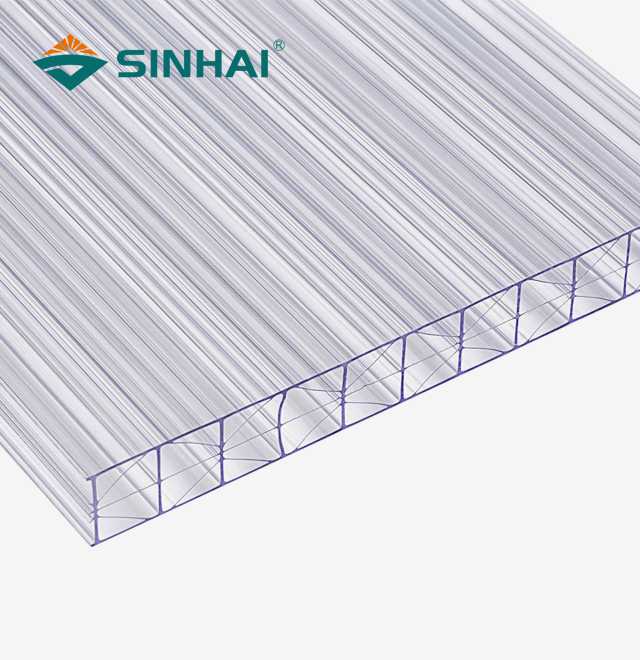
X-Struktur Polycarbonate Sheet — Multi-Wall Panels for Large-Span Roofing and Commercial Glazing
The x-struktur polycarbonate sheet is a structural option when the length of the roof is longer than what normal hollow sheets can handle without drooping. Its internal X-shaped cross-rib design makes it stiffer along the length compared to regular twin-wall or triple-wall panels. This lets steel-frame builders use wider purlin spacing. These panels are made by Baoding Sinhai Sunboard Manufacturing Co., Ltd., a direct manufacturer with ISO 9001:2015 and CE certifications. They come in 10–16 mm thicknesses and let between 65% and 80% of light through.
What Is an X-Struktur Polycarbonate Sheet?
The inside walls of standard multi-wall polycarbonate plates are straight and rectangle. This type of panel has hard X-shaped lattices that run the whole length of it. They are made by adding vertical bars inside each cell.
This shape solves three structural problems that often happen with large-span glazing:
- Midspan deflection under snow load or long-term pressure, which flat-walled panels can't handle without extra support
- Thermal bridging through the core of the panel, which makes insulation less effective in climate-controlled buildings
- A mismatch between weight and stiffness that limits how far apart support purlins can be put
The x-struktur polycarbonate sheet can cover longer open spans than twin-wall sheets of the same thickness because the vertical ribs spread the load across the panel's cross-section instead of putting stress on the flat walls.
Key Technical Specifications
| Parameter |
Value |
| Thickness |
10–16 mm |
| Light Transmission |
65%–80% |
| UV Protection Rate |
98%–100% (co-extruded layer) |
| UV Layer Thickness |
Minimum 50 microns, 1 or 2 faces |
| U-Value (Thermal) |
1.1–1.8 W/m²K |
| Service Temperature |
−40°C to +120°C |
| Impact Resistance |
250–300× that of glass |
| Warranty |
10–20 years |
| Fire Rating |
B1 Grade (GB8624), self-extinguishing |
| Raw Material |
100% virgin PC; SABIC or Bayer resin available on request |
| Standard Colors |
Transparent, bronze, grey, opal, lake blue, amber, dark blue, silver, orange, yellow |
| Certifications |
ISO 9001:2015, CE, RoHS |
Structural Performance
Stiffness and support spacing
The X-rib shape keeps the panel from bending along its length. In real life, this means that across a given roof span, fewer intermediate purlins are needed, which lowers the cost of the steel framing. The benefit is most clear in spans over 1.5 m, where twin-wall panels would need extra support to keep them from bowing outward.
Insulation against heat
The insulation effect of the many air pockets formed by the X-core structure is shown by a U-value between 1.1 and 1.8 W/m²K. This range of performance is better than standard twin-wall panels of the same thickness. This is important for heated or cooled enclosures where the roof's ability to lose energy is a design concern.
Stable UV light
The UV-blocking layer is co-extruded right onto the panel's surface during production, instead of being added as a covering afterward. The thinnest layer is 50 microns thick. The UV inhibitor is permanently attached to the substrate by this process. This stops the delamination or peeling that can happen with post-production treatments.
Temperature and performance are affected
In temperatures ranging from -40°C to +120°C, the panel keeps its shape. Impact resistance is 250–300 times that of glass of the same thickness, which is important for roofs in places where hail is common.
Typical Applications
Industrial and commercial roofing
When roof lengths are long and support frame needs to be kept to a minimum, the X-rib structure works well in warehouses, supply centers, and covered parking areas. The panel can handle loads like snow and wind that would bend lighter-walled options.
Greenhouses for businesses
Between 65% and 80% of light transfer gives you scattered sunshine without a straight beam. The ability to keep heat in helps climate control in places that grow plants all year.
Architectural canopies and walkways with covers
Because the panel has a structured interior and a smooth exterior, it can be used in public places where both weather resistance and appearance are important, like on transit shelters, pedestrian canopies, and stadium concourse covers.
Facades with a lot of visibility
When a building needs a clear outer skin instead of solid siding, the x-struktur panel provides structural depth that makes up for the fact that it doesn't have a hard frame behind it.
Quality Control Process
Before shipping production batches of x-struktur polycarbonate sheet, Baoding Sinhai conducts the following tests:
- Measurement of the UV layer—A spectrophotometer test confirms that the co-extruded layer is at least 50 microns thick across the width of the panel
- Impact resistance: ISO 6603-based falling dart tests are used to check performance under simulated impact loads.
- Thermal aging—QUV rapid weathering studies check the Yellowing Index (Delta YI) to see how stable the colour will be over time.
- Wall thickness uniformity—Ultrasonic gauging checks that the panel's internal X-wall geometry is the same all the way through, finding any differences that could lead to weak spots in the structure.
Sinhai helped write the Chinese national standard for polycarbonate sheets, which went into effect on April 1, 2025.
Customization and Order Options
- As usual, the raw material is 100% fresh polycarbonate. If you need SABIC or Bayer resin, you can get it.
- UV coating: co-extrusion on one or two sides; UV layer thickness between 50 and 112 microns
- Ten basic colour choices, or we can match any colour you want.
- Fabrication: CNC cutting, twisting, cutting to shapes, vacuum making, and thermoforming
- OEM/ODM: Supported; more than 70 moulds are already available for PC products
For information about the production schedule and MOQ that are to your project, please contact the sales team.
FAQ
Q: How is the X-structure different from a panel with three walls?
A: Triple-wall panels have a third flat wall in the middle of the two outside faces. The X-type has vertical ribs instead of those flat internal walls, which makes it more resistant to bending along its length. In real life, this means that the product works better when loads are spread out over long spans. This is because triple-wall sheets are usually designed to be better at keeping heat in rather than being stiff.
Q: Can the sheet be bent without heat?
A: Yes, with some conditions. Because the X-core is stiff, the minimum bending radius is bigger than for twin-wall sheets. Keep the cold-bend radius for a 16 mm X-type panel at least 2,800 mm to keep the internal ribs from stress cracks.
Q: How well does it work in places with a lot of heat?
A: The service temperature ceiling of +120°C covers the highest temperature that dark roofing can get to when it's hot outside. The X-core's insulated air spaces also stop heat from escaping into the building, which is important for buildings in the Middle East and South Asia that are covered.
Q: Does it meet the rules for fire safety in public buildings?
A: The panels are rated B1 Grade under GB8624 and have flame-retardant additives. They go out on their own and don't spread flame. People who want to buy GB8624 B1 should make sure that it meets the fire code requirements in their area.
Q: How are the pieces cut and finished on the spot?
A: A circular saw with fine teeth and a high speed should be used. After cutting, use compressed air to clear out any debris from the inside channels. Then, use aluminium tape or breathable vent tape to seal the cut edges to keep moisture out and keep the structure's integrity.
Contact Us
Do you have more questions about x-struktur polycarbonate sheet? To request samples, technical data sheets, or a project quote, contact us at [email protected].