
 EN
EN
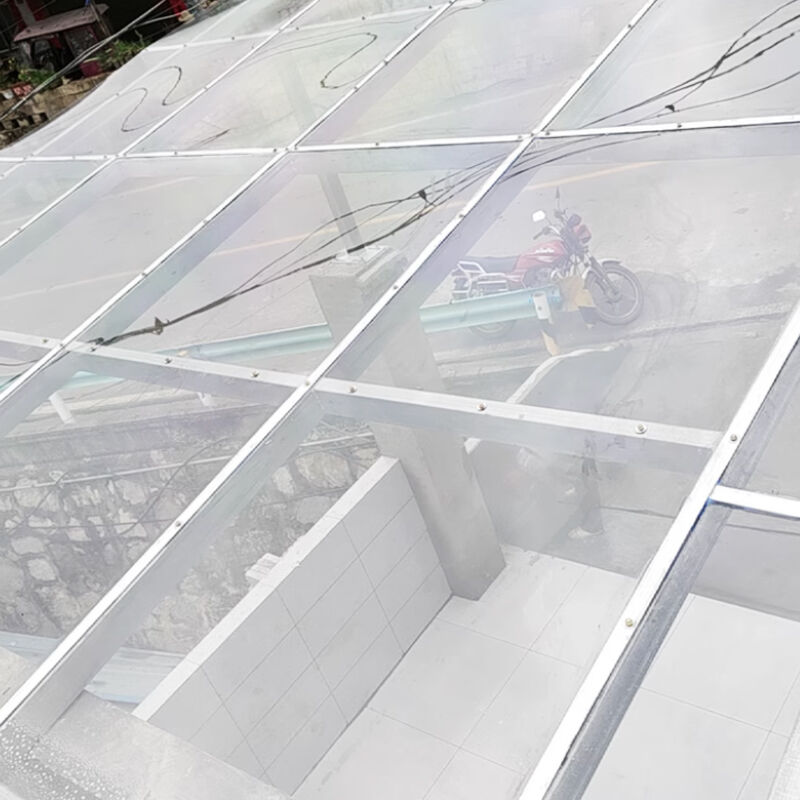
Optical Clarity: Measuring Transparency in Polycarbonate Glass vs. Traditional Glass
Light Transmission (%T) at 550 nm: Lab Measurements and Standardized Benchmarks
Transparency is quantified by light transmission (%T) at 550 nm—the peak sensitivity of the human eye. Per ASTM D1003, standardized measurements show:
| Material | Light Transmission (%T) | Haze Level |
|---|---|---|
| Traditional Glass | 88–90% | <1% |
| Polycarbonate Glass | 86–88% | 1–3% |
Soda-lime glass consistently achieves 88–90% transmission, while optical-grade polycarbonate reaches 86–88%. This near-parity confirms its suitability for transparency-critical applications—from protective barriers to display covers. Yet %T alone is an incomplete metric: two materials with identical transmission can deliver markedly different visual experiences due to differences in light scattering.
Haze and Visual Acuity: Why Surface Scattering Matters More Than Peak %T
Haze—defined as the percentage of transmitted light scattered more than 2.5° from the incident beam—directly governs perceived clarity. Though polycarbonate’s transmission approaches that of glass, its higher haze (1–3% versus glass’s <1%) increases diffuse scattering, leading to:
- Increased glare under bright or directional lighting
- Reduced contrast sensitivity, especially in low-light conditions
- Subtle blurring of fine detail and distant objects
Surface micro-abrasions, common during handling or cleaning, accelerate haze growth in polycarbonate over time. Unlike glass—whose surface remains optically stable—polycarbonate’s softer substrate makes it more vulnerable to cumulative scattering effects. As a result, visual acuity degrades faster even when transmission remains nominally unchanged.
Long-Term Clarity Retention: How Polycarbonate Glass Performs Under Environmental Stress
UV Resistance and Yellowing: ASTM G154 Accelerated Aging Results for Polycarbonate Glass
When left unprotected, polycarbonate materials start to break down when exposed to UV light, showing up as yellow spots and cloudy areas over time. According to ASTM G154 testing standards, these unstable sheets show a noticeable jump in yellowness index (YI) values of around 15 points or more after only 2,000 hours in the lab. That's roughly what happens during one full year outdoors at mid latitudes. The reason behind this color change? UV radiation actually breaks apart molecular chains and creates carbonyl groups within the material structure. These chemical changes cause light scattering effects that make the material look less clear, especially in those blue-green wavelengths that our eyes are most sensitive to.
Optical grade polycarbonate materials now incorporate special features to combat degradation. Manufacturers have started using co extruded layers that absorb UV radiation along with HALS technology which stands for Hindered Amine Light Stabilizers. The combination works pretty well actually limiting yellowing index increases to less than three points while keeping haze formation below two percent even after ten thousand hours of exposure. That translates roughly into over five years worth of actual usage in things like building facades or transportation shelters. When it comes to applications where safety matters most like emergency exit signs or observation windows in control rooms, maintaining material integrity becomes absolutely essential throughout the product lifecycle.
Thermal Cycling Stability: Optical Consistency Across –40°C to +85°C (500 Cycles)
Polycarbonate’s coefficient of thermal expansion (CTE) is ~3× greater than glass, making it susceptible to stress-induced optical changes during repeated temperature swings. In controlled 500-cycle testing from –40°C to +85°C:
- Coated, high-purity polycarbonate shows ≈1.5% haze increase and <3% transmission loss
- Unstabilized variants suffer up to 12% transmission loss and visible micro-crazing
Premium formulations mitigate distortion by balancing CTE through polymer blending and interfacial adhesion optimization. This preserves image fidelity in automotive HUDs, aerospace sensor windows, and industrial machine vision systems—where even 0.3% distortion can compromise calibration accuracy.
Functional Transparency: Refractive Index, Distortion, and Real-World Usability of Polycarbonate Glass
Refractive Index Mismatch and Its Impact on Glare, Reflection, and Image Fidelity
The refractive index of polycarbonate (around 1.58 to 1.59) is actually higher than regular soda lime glass which sits at about 1.52. This difference creates noticeable optical issues when light moves between air and material surfaces or across different layers. The problem gets worse because these mismatches can boost Fresnel reflection losses somewhere around 8 percent, leading to annoying glare problems that make it hard to read information on car dashboards or inside buildings where sunlight comes through. When we look at complex setups like layered security glass or displays with touch functionality built in, all those internal reflections start adding up. What happens then? Contrast drops off significantly and strange ghost images appear, making everything look less clear and professional.
The increased refractive index actually makes those angular deviations worse when dealing with curved or thicker parts. Take a look at lens surfaces or those bent architectural panels, and we start seeing peripheral distortions that go beyond 0.2%. That's way past what's considered acceptable for things like medical imaging screens or high precision optical equipment. Anti reflective coatings sure help cut down on surface reflections to under 2%, but they won't touch those bulk refraction problems. For anyone designing these systems, refractive alignment needs attention right from the beginning of material choices. It shouldn't be something tacked on later as an afterthought. When the optical path matters for actual safety concerns or system reliability, getting this right upfront becomes absolutely essential for good design outcomes.
FAQ
What is light transmission in the context of glass materials?
Light transmission refers to the percentage of light that passes through a material. It's a measure of transparency, commonly measured at 550 nm, where the human eye is most sensitive.
Why is haze an important factor in glass clarity?
Haze refers to light scattering that occurs when light is transmitted through a material. It affects perceived clarity and visual acuity, especially under bright or directional lighting.
How does polycarbonate compare to traditional glass in terms of UV resistance?
Polycarbonate is more susceptible to UV degradation than traditional glass but can be enhanced with coextruded UV absorption layers and HALS technology to reduce yellowing and maintain clarity over time.
What role does the refractive index play in optical materials?
The refractive index affects how light is bent or refracted as it passes through a material, influencing glare, reflection, and distortion, impacting image fidelity and visual clarity.